
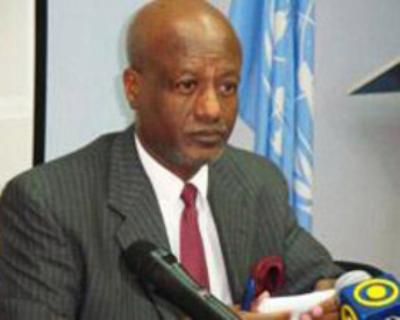

The situation regarding the number of asylum seekers’ applications in Cyprus is manageable and overall there are no major problems, although there are a few gaps and weaknesses, United Nations High Commission for Refugees (UNHCR) representative in Cyprus Damtew Dessalegne has told CNA.
Dessalegne, of Ethiopian origin, was appointed last October and although he has not been here long enough, he says the situation regarding the legal framework is good and the cooperation and communication with the authorities, various institutions and NGOs is on good levels.
He says he would like the Media to get in touch with his office more often to be informed on matters UNHCR is dealing with.
Dessalegne has told CNA that right now there are approximately 2.500 applications from asylum seekers pending, while the rest of the people who are in line to get citizenship are EU nationals or people who are on a student’s visa.
“These people have nothing to do with the refugees, but let me clarify that under our capacity are 6.000 people maximum, including refugees and asylum seekers”, he noted.
UNHCR Representative said that very few refugees live on welfare, adding that it is sad to have a public debate only about refugees and the welfare system.
He pointed out that those people who live on welfare do so because they cannot work, they are either physically incapable or they do not have the experience needed.
Asked to comment on the fact that the Cyprus government is prevented from exercising its jurisdiction over the Turkish occupied north of the country and therefore it may be easier for migrants to enter the Republic from the occupied areas, Dessalegne said that according to statistics, in 2012 only 32% of the people coming to Cyprus entered the country via the Turkish occupied areas.
Asked whether the public debate takes place because there is ambiguous information in the media or the Cyprus society is not tolerant, Dessalegne said that the situation is quite a mix of both.
Dessalegne believes that there is indifference in the Cyprus society, not intolerance and that people are indifference to those suffering.
“This has worsen since the financial crisis but I don`t think is the normal way of dealing with the issue, if every day we see on our TV screen what is happening in Syria and we can’t offer comfort to these people”, he noted. He added however that there are people who live out of the philanthropy of Cypriots.
He said that over the past three years Syria has produced over 2,3 million refugees and the majority of them flew to four neighboring countries (Iraq, Jordan, Lebanon and Turkey) and only 70,000 Syrians have flown to EU countries with the majority of these people (60%) in Sweden and Germany.
Referring to the role of the UNHCR Representation in Cyprus, Dessalegne said that the areas that under the agency’s jurisdiction refer to advocacy to promote the highest standards of protection to refugees and asylum seekers, the strengthening of the capacities of the authorities and NGOs working in these areas and increasing their knowledge on international refugee law, EU asylum law and also presenting them with good practices on what is happening in the EU and outside.
He also said that UNHCR is trying to reach out to other stakeholders from civil society, the media, the academia so that they can cooperate with the agency in legal research activities. According to Dessalegne, the High Commission also works with parliamentarians on the legislation to ensure that it complies not only with the EU but international law.
“The discussion is good, we have access to senior government officials, I can see whoever I want to see, they welcome me very warmly, but in international law, what matters is what happens. I am interested to see results”, he said.
He added that there are major achievements in certain areas, but there are weaknesses in others, for example delays in providing people the essential support for their survival. UNHCR Representative said that there are people who have to wait three and four months, they are unemployed for good reasons, (either they are disabled, or don`t have the skills required and were not supported to acquire these skills).
“Therefore for some reasons they have to rely on the state and the authorities”, he said.
Asked about the conditions in Kofinou reception area and Mennoyeia detention center, Dessalegne noted that the reception area has a capacity for 80 people, it is an open center where asylum seekers are provided with accommodation while they wait for decision in their application.
The capacity, he said, is small and there are 2,500 applications pending.
“So the rest either have to struggle to find accommodation, they cannot work because the asylum seekers are not allowed to work during the first six months, so keeping them in inactivity creates deterioration in their psycho-social setup”, he pointed out.
Referring to the detention center in Mennoyeia, where people are kept for deportation purposes because they have not been provided good reasons to be in Cyprus, Dessalegne described it as the ‘cruel stage’.
He said that most of the times the refugees flee their country because of conflict and arrive here without any documents, without a visa, therefore they are arrested, prosecuted for illegal entry, put in jail to do their term and then sent to Mennoyeia to be deported to Syria, for example.
“And then there is the ban to return to Syria because of the crisis, these people are kept there, in detention and the Cyprus authorities spend all this money, these are areas of my concern and I have raised this issue to the authorities”, he said.
Asked what can be done to improve the situation, Dessalegne said that according to the International Refugee law, the refugees should not be expected to provide proper documents and visas because they flee their countries under very anomalous conditions, therefore they should be excepted from the migration control.
“There is a specific article for asylum seekers who arrive in a country in an irregular manner, that should not be prosecuted and penalized for their act because they did it out for desperation in order to reach safety and this should not be kept against them, the community legislation is recognized here but not practiced”, he noted.
He said that he is not satisfied with the pace the applications are being examined, saying it is very slow. He acknowledge the fact that the services are understaffed, adding that deciding who is a refugee and who is not is a very difficult task and officials have to hear to these peoples’ testimonies and their stories day in and out.
Dessalegne said that all applications should be expedited, not only the negative ones and those that are clearly unfounded cases.
“We have some exceptional cases, individuals waiting for a decision for up to four and five years. They are allowed to work only in the farm and are getting coupons and before they were applying for benefits, these people cannot travel, they have no documents and keeping them here only worsens the situation. There are different ways to accelerate the process and I will continue to discuss it with the authorities”, he noted.
According to UNHCR data, in 2013 847 new applications were submitted to the Asylum Service, and there were 386 appeals to the Reviewing Authority. So far applications pending examination are 1,320 for the Asylum Service and 1,104 for the Reviewing Authority. 34 persons were given refugee status, 98 subsidiary status, 37 are under humanitarian statues. Overall there were 983 and 661 applications were considered closed.
Dessalenge expressed his concern over the fact that there is little public debate in Cyprus about Syria. “The greatest catastrophe of modern times and very little is being discussed, and it is happening just across the street sort of speak,” he said.
Dessalegne mentioned that there is a strong Syrian community in Cyprus that should be heard and that Cyprus can play a humanitarian role in this tragedy.
He said UNHCR is an authoritative agency and all the information it gives out is credible and objective.
UNHCR Representation in Cyprus began its operations in August 1974 following the Turkish invasion of the island in order to provide humanitarian assistance and support to Greek Cypriots and Turkish Cypriots.
The Office was responsible for the accommodation of the refugees, their economic assistance, the organization of bicommunal events etc. This action was taking place up until 1997. At the same time, following a request by the Cyprus government the office was responsible to assess the applications of asylum seekers.
Since 2002 the Cyprus republic has taken over this role and the UNHCR office has returned to its traditional role and actions thus the protection of the refugees’ rights.
The Office makes suggestions and proposals to the competent authorities, provides education and technical support to the officials who examine the asylum applications and makes sure that the Republic is following the EU and International law.
It also takes action in the field of raising awareness and organizing events to inform the public.