
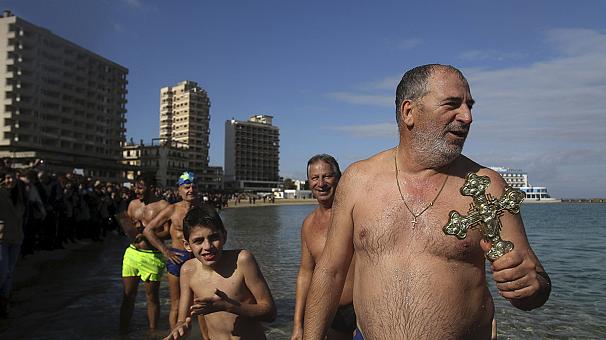

Epiphany celebrations took place on Wednesday in the Turkish occupied town of Famagusta for the first time since the Turkish invasion against Cyprus in 1974.
Pilgrims from all over the island attended the liturgy of Epiphany in the St George Church (Agios Georgios Exorinos) which lies within the walls of the old city of occupied Famagusta.
They then proceeded to the `Glossa` beach where the blessing of the waters took place, a ceremony that includes diving to retrieve the Holy Cross which the priest throws in the water, according to the Greek Orthodox tradition.
It is said that around 1,200 pilgrims attended the celebrations
Cyprus has been divided since the Turkish invasion of the island in the summer of 1974. The Turkish military still occupies 37% of the EU Mediterranean island`s territory. UN-led talks are underway in a bid to reunify the island under a federal roof.
For the first time in decades, Greek Cypriots celebrated Epiphany on the northern side of ethnically-split Cyprus on Wednesday, as momentum builds for a possible breakthrough this year in peace talks.
Against the backdrop of abandoned hotels and homes ringed with barbed wire, a robed Greek Orthodox priest tossed a cross into the sea, symbolising a blessing of the waters, and the baptism of Jesus in the River Jordan.
About fifteen people plunged into the icy waters. In Orthodox tradition, the person who retrieves the cross is blessed.
Though Turkish Cypriot authorities have permitted crossings of Greek Cypriots to the north since 2003, religious events by Greek Cypriots have required permission.
In a sign of an improving climate between the two sides which many hope can translate into progress in peace talks, Turkish Cypriot authorities sanctioned the Epiphany celebrations on a beach at Famagusta for the first time since the war.
“This is a very moving moment for me … our presence here means we haven’t forgotten, and we still believe one day we will return,” said Greek Cypriot Philippos Yiapanis, one of hundreds who lined a white sandy beach to observe the ritual.
He was 17 when he left Famagusta, a sprawling town on Cyprus’s eastern coast. He is now 59, and for most of his life, Cyprus has been divided.
Now, diplomats have hope peace talks between the two current Cypriot leaders, Nicos Anastasiades and Mustafa Akinci, can achieve what an army of others failed. Both sides have reported progress in talks, though caution that plenty of issues are still unresolved.
Varosha, a suburb of Famagusta where hotels and homes have been left to rot is a poignant reminder of the conflict tearing Cyprus apart.
Ringed by a fence which extends into clear blue waters, the six-square kilometre suburb has been off limits to anyone but the Turkish military since its 39,000 residents abandoned it in the face of an advancing army in August 1974.
The closest pilgrims got to it on Wednesday was peering through a fence on the beach. One man fell to his knees, filling a water bottle with sand to take home.
“I cannot express how I feel,” said Vassilis Theofanous, 54, whose eyes welled with tears. “I was 14 when I left…I hope something happens this year and we solve the Cyprus problem, for everyone to return to their homes.”
Negotiations have stepped up pace since the election of Akinci, a moderate, to the helm of the Turkish Cypriot community in April 2015.
Anastasiades, who has been President of the internationally-recognised government of Cyprus since 2013, has supported initiatives in the past – most notably backing a U.N. reunification blueprint in 2004 which however failed to muster backing from Greek Cypriots in a referendum.
But optimism is also tempered by past failures. And talks have barely touched upon issues like redrawing ethnic boundaries or dealing with the property claims of thousands of internally displaced people.
“What is happening today maybe gives a message that we can expect a very productive 2016,” said Alexis Galanos, the Greek Cypriot mayor-in-exile of Famagusta.
“I don’t want to be over-optimistic, because many times up to now we have been disappointed but there is all around a cautious optimism,” he told Reuters Television.
Reuters