
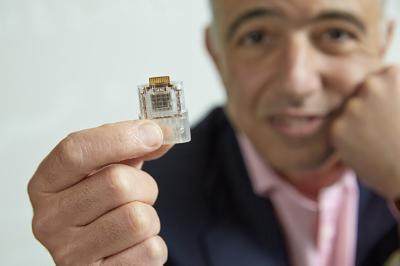

UK scientist of Cypriot origin, Christofer Toumazou, whose father is from Neta was awarded on Tuesday with the European Inventor`s Award in the category of Research, in a ceremony that took place in Berlin.
The eminent professor of electrical engineering and director of the Institute of Biomedical Engineering at London’s Imperial College invented a microchip that can analyse genetic disorders within minutes and without the need for a lab. Thanks to Toumazou’s technological innovation the early detection of an increased likelihood of hereditary conditions such as Alzheimer’s is a veritable milestone on the way to a medical science that focuses on preventing diseases.
President of the European Patent Office, Benoît Battistelli said that “Toumazou’s invention opens up far-reaching perspectives in the preventive medical treatment of disease”.
Professor Toumazou is of Greek-Cypriot decent – his parents lived in Yialousa in the Turkish occupied district of Famagusta until the late 1950s, and moved to the UK shortly before he was born. He and his family have maintained strong links with the island, and he has been a mentor to Cypriot science students in the past.
By the time he was 33 years old he was Imperial College London’s youngest professor.
In an interview he gave to the Cyprus News Agency (CNA) some days ago, the Professor said that in a few years’ time medicine will be very different, adding that “and it’s this technology that will then drastically reduce the time to get a result”.
“With technology like this, doctors will then be looking at your medical future instead of your medical history”, he stressed.
Toumazou`s DNA chip can detect hereditary mutations such as diabetes, neural diseases, metabolic diseases etc. as specific reagents can be designed for the chip.
Invited by CNA to give more details about his DNA testing, he said that the centrepiece of the invention is a microchip that rapidly analyses genetic changes. The chip is called Genealysis.
“If there is an abnormality or deviation, the composition of the human genome changes. The modified strands compare the test with the DNA of the subject”, he told CNA.
Professor Toumazou went on to say that “we only need a small DNA sample from someone”.
Toumazou holds more than 50 patents, 40 of which are related to healthcare and semiconductor technology. He is considered to be a pioneer of personalised medical diagnostics, combining medicine and electrical engineering. All his inventions revolve around microchips that are able to analyse data immediately.
In 2015 this quick test will be used in clinics to help detect infectious diseases and other diseases.
“Our test is already in use in the cosmetics industry today: Using a chip, the DNA of the skin is analyzed. The data then helps the customer get the personalized product – tailored to their skin type”, he told CNA.
The market potential for DNA sequencing is immense. By 2016, it is expected to be worth US $6.6 billion and grow by 17.5% annually.
The European Inventor Award
———-
Launched in 2006, the European Inventor Award is presented annually by the European Patent Office. The award honours inventive individuals and teams whose pioneering work provides answers to the challenges of our age and thereby contributes to social progress, economic growth and prosperity.
Asked about the European Inventor Awards, Professor Toumazou told CNA that “This is an award that I hope will demonstrate not just to Europe but to the world that a technology like this can be used to help mankind”.
The awards were presented to winners in the following categories: Industry, Non-European Countries, Small and Medium-Sized Enterprises (SMEs), Research, Popular Prize and Lifetime Achievement.
Christofer Toumazou competed in the category of research together with the other finalists, who were Thomas Tuschl (Germany) for gene-silencing technique to treat diseases and Philippe Cinquin, Serge Cosnier, Chantal Gondran, Fabien Giroud (France) for implantable biofuel cell that runs on glucose.
The other winners are:
1. Lifetime achievement: With over 1 100 applications for patents and utility models, Artur Fischer (Germany) is one of the most prolific inventors of all time. His invention and namesake, the expansion plug (or “Fischer wall plug”) revolutionised the construction industry in 1958 and has been used billions of times around the world ever since.
2. Industry: Koen Andries (Belgium), Jérôme Guillemont (France) and team were distinguished for their efforts in developing the first new effective tuberculosis (TB) drug in 40 years.
3. Small and medium-sized enterprises (SMEs): Peter Holme Jensen, Claus Hélix-Nielsen and Danielle Keller (Denmark) received the Award for their invention of a water-purifying membrane coated with aquaporins, which purifies water without consuming large amounts of energy.
4. Non-European countries: Charles W. Hull (United States) received the European Inventor Award for his invention of 3D printing – a technology that is currently in use in numerous fields and that has triggered a veritable revolution in manufacturing. Although a multitude of different procedures for 3D printing now exist, they all build on Hull’s original invention.
5. Popular Prize: Masahiro Hara, Takayuki Nagaya and team (Japan) : They invented the QR (Quick Response) code. Among other things, it is used for managing inventory in factories, administering patient files, tracking biological samples and as a marketing tool.