Dear guests,
Friends,
A Cypriot phrase says, “It is the people that make the place”.
This was my initial thoughts on the anniversary of Cyprus Independence.
Together with an image: “The World of Cyprus” painting by renowned Cypriot painter Adamantios Diamantis. It was as if this painting – all 17.5 metres of it – embraced the soul of an entire people.
Figures seemingly created from the soil and sweltering heat of Cyprus. Faces captured by the artist on paper from 1931 to 1959, one year before Independence was declared. He finally began painting his monumental work in 1967 and completed it in 1972.
I chose to begin with this work of art because I recognize in these faces pieces of memory from my own childhood. Cyprus had already begun to change in 1965 when I was born, but the place and the people were still fundamentally simple and honest.
The open wound of the bicommunal clashes which broke out between 1963-’64 did not permit anyone to pretend that the early years of the Republic of Cyprus had been fruitless. The clouds over our country were gathering because of the conspiracies being prepared abroad and also because those who signed the agreement for independence – the Right in both communities – did not respect it and didn’t believe in its outcome. They were constantly undermining independence, while at the same time instrumentalising the state for their own personal and petty-factional gains.
Nevertheless, the instinct of survival and the desire to get the young state on its feet inspired our people.
We, the children of the 1960’s, could not see the clouds that were gathering on the horizon. We could not see the wound of bicommunal conflicts that was festering, nor did we understand the toxic way the Greek Junta with its puppets here was polluting the country. We were not in a position to suspect how fragile the Republic of Cyprus was and how much it was in danger from the illegal actions of so-called “patriots” who were playing with fire.
My own world extended to the borders of my village Gerolakkos, to the plain with its crops and to the planes flying above our heads at the nearby Nicosia International Airport. Our life was simple: lots of football, watching movies at the village cinema and going to the big feast of St. Mamas, our friends, our games, our backyards….Until one day it suddenly became dark. And then everything changed.
My generation, including me, was forced to come of age abruptly that during that summer of 1974. Almost ten years old, I abandoned the village amidst the pandemonium caused by the bombings of Turkish fighter jets. What we left behind as refugees was a Cyprus that would never exist again. We didn’t know that then. We discovered this in the years that followed, in the cruelest way.
From our very adolescence we acquired, willingly or unwillingly, clear perceptions of what we call Independence. Or to be more precise, the rape of our Independence, which my generation did not get to live through.
We were raised in a shackled state where a tragedy was unfolding all around us: dead, missing persons and uprooted people as refugees – a broken people in a looted country.
It was now up to everyone to understand how we got to that point. Personally, I chose to view life from a left perspective and that is how I understood History.
That is precisely why I insist on reminding, at every opportunity, of the treacherous role played by those who dissolved democracy. Condemning the coupists is not an obsession, nor is it some kind of ideological fixation. It is the only way of resisting the falsification of History, which is of enormous importance for charting the correct course for the future.
If we do not want tragedies to be repeated, we must know what happened in this country. Otherwise we are doomed to survive as stowaways on the train of history. We don’t have such a luxury – in fact we never had – in the contradictory and dangerous modern world, where one pays a heavy price for any illusions and slogans. This is one of the most crucial lessons to be drawn from Cypriot history.
I often hear certain forces and circles say that AKEL, by pointing out the treacherous role of the armed fascist underground organisation of EOKA B and those who politically nurtured it, ends up in off-sets that exonerate Turkey for the crimes it has committed in Cyprus. Although I feel that there is no point in repeating the obvious, today gives me the opportunity to recall our long-standing position. That is to say, the crime of the Turkish invasion is neither off-set, nor pardoned. To do so would be an insult to the memory of the dead, the wounded and the missing persons, and of all those who left a part of themselves in their occupied land.
It is our conviction, however, that if the coup had not taken place, the Turkish invasion would not have followed. This fact makes the coupists, both Cypriots and Greeks, co-responsible for the Cyprus catastrophe.
On the other hand, we do not want to be swallowed up by the darkness of History. We owe it to our children and grandchildren to fight for a solution and try to heal the wounds.
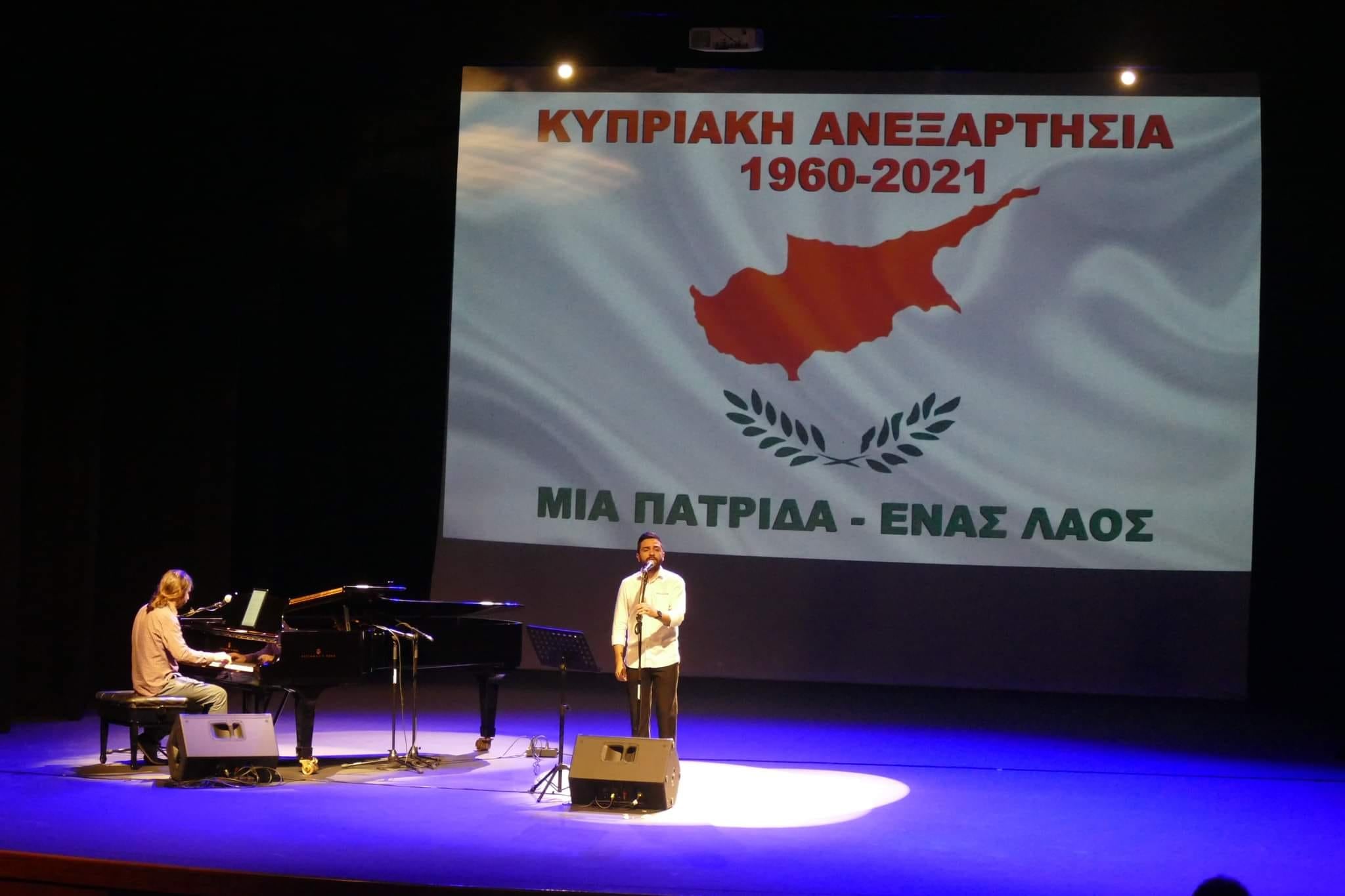
The anniversary of Cyprus Independence Day is the ideal occasion to look back soberly at the past, to understand where we are and to renew our belief in the effort to resolve the Cyprus problem.
We have been hearing these things for so many years that I am afraid now sound like stereotype phrases. But they are in fact true, since, almost half a century after the invasion, we are in serious danger – more serious than ever before – of being led to the permanent partition of Cyprus.
This year’s anniversary, sixty-one years after the declaration of Cyprus Independence, finds us confronted with an ominous political reality: on the one hand, Turkey’s unprecedented provocative actions, which is now officially promoting and insisting on a two state solution. On the other hand, the conflicting and unrealistic policy of the President of the Republic of Cyprus, which gives the occupying power room to plan new serious occupationist fait accompli without suffering any real political cost. The most recent example of this erratic contradictory policy is the President’s novel idea, in 2021, of returning to the 1960 Constitution!
As AKEL, we had no intention of continuing this unproductive, completely out of place and time debate, but Mr. Anastasiades’ insistence forces us to do so. Apart from the obvious – namely that the revival of the 1960 Constitution with its guarantees, vetoes, intervention rights, etc. – is completely untenable, we are very seriously concerned about the recklessness with which the government ruling forces are handling the Cyprus problem at its most critical juncture.
I will therefore take the opportunity afforded to me by this year’s Independence anniversary to reiterate our positions, codified, so that there is no confusion as to what AKEL stands for:
● Our starting point is the conclusion that the situation surrounding the Cyprus problem is so critical that the danger of permanent partition is visible and immediate.
● Turkey, with its illegal occupation and violation of the resolutions of the UN, not only bears the primary responsibility for the current stalemate, but is overtly working on partitionist plans.
● The Turkish Cypriot leader Ersin Tatar is a willing accomplice to this tactic by abandoning the agreed basis for a solution of a bizonal, bicommunal federation and promoting the proposal for a two state solution.
● Having clarified the above, the principal task now is to determine how our side acts to counter the Turkish machinations.
● Unfortunately, Nicos Anastasiades’ handlings are characterised by contradictions and regressions, with the most characteristic example being the unhistorical proposal for a return to the 1960 Constitution.
● For AKEL, there is only one path of the Cyprus problem and it is not negotiable: Persistence and consistency to the High-Level Agreements and the Resolutions of the UN. Any “new ideas” distract from the sought goal, which must be to resume the negotiations from where they were interrupted at Crans Montana, preserving the convergences agreed and negotiating on the Guterres Framework.
● We have also tabled a proposal (on the Cyprus problem), since last December, on how the UN Secretary General’s position can be implemented, as set out in his latest Report, for making use of natural gas and turning it into a catalyst for the resumption of the negotiations. In AKEL’s view, our proposal is fully in line with what the UN Secretary General himself proposes as a way to break the damaging deadlock and resume the negotiations. The very fact that AKEL’s proposal on the Cyprus problem meets Mr. Guterres’ “wishes” should have made the President more receptive to our proposal, since its promotion by him would, if nothing else, contribute towards restoring his credibility, which – according to the admissions of even his own close associates – is non-existent. And when you have no credibility, you do not convince.
I will not go on at length about the Cyprus problem, because what is important right now is that we understand the big picture: the agreed framework of the solution and our commitment to finding common ground despite the other side’s unproductive stand in order to break the deadlock.
The reference to the big picture instinctively reminds me of the ‘big picture’ referred to by the emblematic composer Mikis Theodorakis in the sunset of his life. As I attended his farewell ceremony in Athens, this is what I kept thinking about constantly: how big pictures/sizes transcend the wear and tear of everyday political engagement and how they force us to confront our ideas and political selves.
We are often asked by various people: But is it possible, facing such a Turkey, to expect that whatever we may do, Turkey will accept or at least be obliged to cooperate for a solution that liberates and reunites our country? The answer is simple: the ongoing stalemate and protracted Cyprus problem suits Turkey. As it has been demonstrated many times over, the passage of time without a solution is convenient for and serves Turkey’s plans.
We don’t have the luxury to wait, nor can we afford to stay apathetic. We have never had such a luxury, let alone now that we are facing the permanent partition of our country. It has always been imperative that we should take concrete initiatives that overcome the deadlocks and move the negotiation forward on the agreed basis for a solution. Through our targeted initiatives we must hold Turkey to account. If Turkey responds positively, then we will achieve a solution. If not, let it be exposed for its intransigence.
Several people are raising the question: do you trust Turkey to agree a solution with it? We answer: no, we do not. And that is precisely why we are fighting for a solution that provides for the speedy withdrawal of the occupying troops, for an end to guarantees and interventionist rights. For a solution that will free Cyprus from Turkey’s suffocating stranglehold. The non-solution of the Cyprus problem holds Cyprus and our people, Greek Cypriots and Turkish Cypriots, hostage to Turkey.
We must not be afraid of negotiations. We must be seeking them. Fear has never served the prospects of solving the Cyprus problem. All fear causes is trapping ourselves which merely perpetuates the de facto situation and increasingly slides towards a deteriorating situation. Fear in politics inhibits logic. Populism terminates rationalism. Conspiracy theory abolishes political thinking. That is why we are constantly confronted with all this, especially on the Cyprus problem.
And if some people think the solution is unfeasible, let them draw lessons from history, which has proven countless times that change does not come by itself. It emerges by starting with resistance to the seemingly inevitable. If this isn’t done, no one will ever know how inevitable the inevitable actually was. We do not consider partition inevitable. Even more so, we will never accept it, because partition means new adventures and new dangers for our people and country.
Let it not escape anyone’s attention that no one can change geographical positions. What we can and must change is the terms and context of relations between neighbouring countries. It is proven – and indeed logical – that it is not in our interest and it is extremely dangerous to have Turkey as an adversary. That is why we must do everything in our power to solve the Cyprus problem and through this to build good neighborly relations with the current occupying power. It is difficult, but imperative.
I said at the beginning that my generation grew up and found its way in the decades when the Republic of Cyprus took its first tentative steps. The turning point was the summer of 1974, which led us, whether willingly or not, to a premature political awareness.
Those of us who chose the left side to perceive the world, as the years went by, formed a very specific view of how we wanted our country to be. Independence is just a word, a moment in the vast landscape of history, to which we are called upon to give a meaning.
That is why I will return to the truth contained in the Cypriot phrase “it is the people that make the place”. It is this purity in people’s souls that we, as the Left, want to safeguard first and foremost. By honoring Independence, we honor the common people of Cyprus, all those who are struggling to stand up for themselves without selling out principles, values and ideals.
Looking at the world from the left perspective, we redefine ourselves and our role as a Party: sixty-one years of independence, we have an obligation, more than ever before, to stand by the weak/vulnerable and defend the welfare state and the rule of law.
These are not empty words, you understand, but a conscious political and ideological stance because ideology is not mere symbols and quotes; it is concrete examples ‘on the ground’.
That’s where we will measure our strength as AKEL. And there, in the streets of real life, we will meet again with those who have a vision, are struggling and aspiring for a better Cyprus. It is on these paths that for almost a century AKEL has been writing its own history, which our generation has undertaken to continue in difficult and contradictory times.
We envision a Cyprus of which we will be proud. One that will not give anyone the right to consider us internationally as a state/flag of opportunity for wanted crooks or a synonym for the Seychelles (Note: reference to the ‘golden’ passports scandal).
We envision a Cyprus where the state and its institutions will uphold justice, rights, equality before the law and will serve transparency and good governance, all of which have been dealt a severe blows in recent years by the current government.
We envision a Cyprus as a common homeland for Greek Cypriots and Turkish Cypriots, Maronites, Armenians and Latins, where we can at long last live in peace and security.
This is how AKEL commemorates Independence Day: by renewing our pledge to the people that we will struggle with all our strength for a workable and viable state, which in conditions of freedom and democracy will ensure lasting peace and cooperation for all its inhabitants.
A country that will also be a bridge of peace and cooperation in our long-suffering region.