
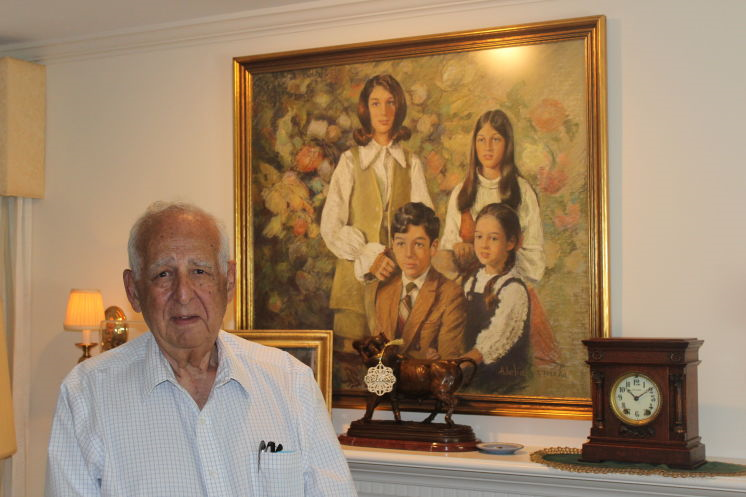

Raised in Altoona, Pa., the Penn State University and Emory University grad quickly fell in love with the state and began his medical career as a family practitioner.
Crist started at Mound Park Hospital, now called Bayfront Health St. Petersburg. Then he practiced at Mercy Hospital, where he treated black patients during segregation. But he spent the bulk of his 55-year career at St. Anthony’s Hospital.
The doctor also participated in a host of professional organizations and served on the Pinellas County School Board, where he was chairman from 1975-77.
After thousands of patients treated and hundreds of babies delivered, Crist, now 84, retired last month.
Now the grandfather wants to focus on spending time with family. Elizabeth Crist Hyden, 57, is a radiation oncologist. Catherine Crist Kennedy, 50, is an associate vice president at St. Petersburg College. His son, Charlie Crist Jr., 59, served as governor of Florida and is now running for Congress.
Dr. Crist’s eldest child, Margaret Crist Wood, died at the age of 60 in 2015. She was a schoolteacher who later managed her husband’s law office.
The doctor recently sat down with Tampa Bay Times staff writer Langston Taylor to discuss his career, his father’s inspiration and his politics.
How did the role of a general practitioner change over your career?
We made house calls. I haven’t made a house call in 20 years, but in those days we made a lot of house calls. Half our practice was house calls. We got $5 for an office visit and $7 for a house call.
People got sick, they went to the doctor. They didn’t go to emergency rooms like they do now. We had emergency rooms, but they were really utilized more for almost strictly what we call trauma stuff now. And so people just went to their family doctor, and we’d put it on the tab. That was part of it, we accepted it.
People were very appreciative. There was no lawsuits. We carried malpractice (insurance) with a company called Indiana Medical Protective. My premium was about $35 a year and my coverage was $10,000. Nobody ever got sued. There was very goodwill, and that’s why. It wasn’t that mistakes weren’t made, but people were understanding. They knew what you were trying to do and that that’s the best you had.
On house calls, I would not only give a shot if I had to, but I would dispense a prescription. But all that has changed, and really for the better. … I mean the medicine is so, so far advanced now (compared to) what we had to deal with. You were in the middle of the night, and somebody’s home, trying to figure out what’s going on. You didn’t have access to CT scans, MRIs. You had your hands and your brains. And you had your inquisitiveness. You did what you could.
What do you wish you knew when you started out?
It wasn’t anything like ‘I wish I knew more.’ One of the things that really stood out in my mind, and I always passed this on when I made rounds with younger physicians … (came from) one of my great professors at medical school. … If you listen to your patients, if you listen to them long enough, they’ll tell you what’s wrong with them. And I never forgot that.
Was there someone who helped guide you along the way?
My father (Adam Christodoulos, who died at age 96 in 1991), probably was the most important individual in my life. When I was growing up, I always wanted to be a lawyer.
My dad was an uneducated man. He was an immigrant — Cypriot immigrant — but he was bright, and he was industrious, and he was a good businessman. We had a dry cleaning business, and we had a cafe, a bar-restaurant combination. … Our cleaning place was on the street where the doctors had their offices. …
(My father) said about the doctors, “Well, they’re respected by everybody, they do good work. … You got some brains, Charlie, so why don’t you go be a doctor?” He didn’t think much of lawyers, I don’t think. That’s how I became a doctor — he told me to.
What from him have you tried to emulate as a father?
I think because he was an uneducated man, he really wanted everybody to be educated — all his children. And he insisted on that, and he worked very hard for that. So the value of education was sort of drilled into us as kids. He said, “If you’re in this country and you had land and factories, then you didn’t need all that. But all you have are your energy and your brains. … You got to try to utilize that, while you’ve got it, so you better do the best you can with it.”
And he was right. And I still think that’s pretty good philosophy.
When I have immigrants in my practice, I try to pass that on to them, particularly if I see a little energy and intellect and brightness, I want to make sure, because sometimes they’re not encouraged when they should be. And a lot of times what you end up (as), depends on what kind of encouragement you get … particularly teenagers, that are insecure anyhow, so if they have just a little bit of inspiration like that coming from someone who represents a little authority or something, you can make a world of difference.
How did you approach your work on the Pinellas County School Board?
I was raised up North, and we were completely integrated. We did not have segregation. So I was never a big fan of the segregated school system. And I always felt that you should be able to go to school wherever you lived, and you shouldn’t have to be sent somewhere else. And I used to try to do that when I first came on the board. I couldn’t get anywhere with it. It probably wouldn’t have helped too much anyhow, because the community was segregated. But it would have helped some. And it would have been a start. I always saw, from day one, I saw African-American patients. Some of the doctors in those days still didn’t do that. It was still pretty Southern here; it was amazing.
 Charlie Crist Jr
What’s it been like watching your son’s political career over the years?
(Charlie Crist Jr.) got the political bug. He’s a good man. He’s honest, he’s hardworking, he’s well-motivated. He’s a Democrat now, and I’m a Democrat now.
When did you become a Democrat?
That happened about six months ago. (Reporters used to ask his son) “Well, do you think any of the old Republicans that used to vote for you will still vote for you?” He said: “I think my father will.” Blood’s thicker than politics.
Plus, you know, it’s changed. The political climate is very different than what it was 50 years ago. I think some of the Democrats are way too radically liberal, and I think some of the Republicans have become way too radically conservative. The radicalism is what’s scary, on both sides.
TampaBay.com