

The Olive Tree
Olives and olive oil were not only an important component of the ancient Mediterranean diet, but also one of the most successful industries in antiquity.
Cultivation of the olive spread with Phoenician and Greek colonisation from Asia Minor to Iberia and North Africa and fine olive oil became a great trading commodity right through to the Roman period and beyond. The olive also came to have a wider cultural significance, most famously as a branch of peace and as the victor’s crown in the ancient Olympic Games.
Geographical Spread
The olive was first cultivated around 5000 BC, or even earlier, on the Carmel coast of ancient Israel. Here simple olive presses have been excavated at the Neolithic site of Kfar Samir. The success of the industry is attested by records of olive oil exports to Greece and Egypt throughout the 3rd millennium BC. Greece started to produce its own olives on Minoan Crete and Cyprus in the Late Bronze Age and, thereafter, on the mainland.
The Greeks, like the peoples of the Levant, were soon producing a surplus of olives and olive oil so that they built up a lucrative export industry. Such was its importance that it was the only permissible export in the celebrated laws created by Solon (c. 640 – c. 560 BC).
With the process of Phoenician and Greek colonisation olive trees (Olea europea) sprang up across the ancient Mediterranean where all that was needed was warm summers and relatively light rainfall for these hardy trees to thrive.
Trees were spread to new areas by planting cuttings and ovules (trunk growths), or grafting domesticated trees onto wild ones. The Romans planted their cuttings in dedicated nursery beds to help them on their way. Long-lived and drought-resistant, the tree was a handily low-maintenance form of farming. Olive growers usually planted their trees in amongst fruit trees and reared animals so as to have some income in case of an olive crop failure, and it was an easy way to keep groves grass and weed free. The residue from pressing oil from olives could also be used as feed, especially for pigs.
From the 1st to 3rd centuries AD, the Romans spread olive cultivation to more marginal growing areas such as central Tunisia and western Libya, which required extensive irrigation systems to make the farming viable.
The Romans dependency on olive oil is illustrated by Septimius Severus decision to collect it as part of the taxes imposed on provinces and then redistribute it to the populace of Rome.
As the Roman Empire expanded, so too did demand for olive oil, with Constantinople becoming one of the biggest importers. Indeed, the establishment of a huge number of olive farms (and vineyards) across Syria and Cilicia to meet this demand, are credited with creating a regional economic boom in the 3rd-5th centuries AD.
The largest olive producers in the ancient world then were Greece, Italy, the Levant, the North coast of Africa, Spain, and Syria. Places which enjoyed a particularly high reputation in antiquity for fine quality oil included Attica, Baetica (in Spain), Cyrenaica (Libya), Samos, and Venafrum (Italy).
Production
Table-olives (made edible by salting) were eaten, but most of the crops produced went into making oil. Although oil was a common product, it was not necessarily a cheap one and, as with wine, there were different grades of quality. Olive trees produce a full harvest only every other year, sometime from October to December, and the Greeks believed that the earlier they were harvested (when still green) and pressed, the finer the oil. However, leaving collection later in the season allows for the olives to continue growing, ripen so that they become black, and so more oil can be pressed from them. The finest quality oil, as today, came from the first pressing and when the mash had the minimum number of stones in it.
Olives were crushed either underfoot (the crusher wearing wooden sandals), with pestle and mortar, using a stone roller, or in presses, the first mechanical ones coming from Klazomenai in Turkey. Dating to the 6th century BC, these used a beam anchored to a wall and a stone weight to increase the pressure and efficiency of the press.
As with most areas of everyday life, the Romans went one step further and made oil on a much larger scale. Large estates are described in detail by such authors as Cato. The Roman writer describes in his De agricultura the annual yield of one producer as between 50,000 and 100,000 litres of oil. The Romans first used a circular stone press (trapetum) which consisted of a large stone bowl (mortarium) into which the olives were poured and then crushed under two concave stones (orbes) attached to a central beam (cupa) fixed to an iron pivot (columella). This apparatus then slotted onto a central post (miliarium) set into the bowl which allowed the stones to be turned inside it. These rotary stone mills often harnessed animal power using mules to further increase efficiency.
The Romans also moved on from the traditional beam and winch press to screw presses which dramatically increased the crushing pressure. This helped meet the ever-growing demand for olive oil as the empire expanded and resulted in production quantities not seen again until the 19th century AD.
Once pressed, the oil was drained off into a large stone settling tank set in the floor of the press room. Here the liquid mix of water, olive juice, and oil would settle and the oil rose to the surface where it could be skimmed off using a ladle or, alternatively, a tap in the base of the tank could be opened to drain away the water. When ready the finished oil was then stored in terracotta containers.
At a pressing workshop on Delos, six large pithoi vases held up to 4,000 litres of oil. There are records that oil produced in North Africa was shipped to Rome in oilskins. The most common storage vessel, though, was the amphora. These were very often stamped with such information as the producer’s mark, place of manufacture, or production date, and then, if not used locally, were shipped across the Mediterranean.
Uses
Not only were olives and olive oil an important part of the Mediterranean diet and cooking process (and still are, of course) but the oil produced from pressed olives was also used for many other purposes. Greeks and Romans used it to clean their bodies after exercise – smearing it on so that it collected dirt and sweat and then scraping it off using a metal instrument called a strigil. Olive oil was used as a fuel in terracotta (and more rarely metal) lamps, as an ingredient of perfumes, in religious rituals, for massages, as a multi-purpose lubricant, and even prescribed as a medicine.
Impact on Culture
The importance of the olive to Greek culture is seen in the appearance of the olive branch on Classical Athenian coins and its use in the crowns of victory at the Olympic Games. The Athenians considered the olive tree a gift from their patron goddess Athena, and this very tree grew on the acropolis of the city. They had an entire sacred grove of olive trees (moriae) too, from which oil was pressed and placed into uniquely decorated amphora vases to be given as prizes in the annual Panathenaic festival.
Olive branches came to signify peace. Herodotus tells us that in the early 5th century BC Aristagoras of Miletus carried one when he went to negotiate help from Cleomenes during the Ionian Revolt against Persia so that he would not be turned away from the Spartan king.
Olive branches were also carried by pilgrims who visited the sacred oracle of Apollo at Delphi. The Romans continued this association and often depicted the god Mars, in his lesser-known guise as the bringer of peace, carrying an olive branch.
Olympic Prizes
The Hellanodikai (trained judges from Elis) gave out the victory crown (kotinos) of wild olive leaves and an olive branch cut from the scared tree (Kallistephanos) to each event winner.
The olive was significant because the trees of Olympia were believed to have been originally planted by Hercules. Another prize could be a red woollen ribbon which was worn on the upper arm or around the head, especially for chariot racers as it was the horse owner who actually received the olive crown.
Herodotus
The Greek historian Herodotus describes the following story which is relevant to the olive wreath. Xerxes the Persian king was interrogating some Arcadians after the Battle of Thermopylae. He inquired why there were so few Greek men defending the Thermopylae (Gates of Fire).
The answer was “All other men are participating in the Olympic Games”. And when asked “What is the prize for the winner?”, “An olive-wreath” came the answer. Then Tiritantaechmes, one of his generals uttered: “Good heavens! Mardonius, what kind of men are these against whom you have brought us to fight? Men who do not compete for possessions, but for virtue.”
Amphora
An amphora is a jar with two vertical handles used in antiquity for the storage and transportation of foodstuffs such as wine and olive oil.
The name derives from the Greek amphi-phoreus meaning ‘carried on both sides’, although the Greeks had adopted the design from the eastern Mediterranean.
Designs
Evolving from the large Bronze Age pithoi vessels, which the Minoans and Mycenaeans used for storage purposes, the amphora became perhaps the most common ancient pottery shape. However, the size and form had a great many variations. Amphorae could also be plain – typically when used for the transport of goods – or highly decorated, just as any other red-figure or black-figure pottery. Specific places, already noted for their pottery production, such as Corinth and Attica, along with famed wine-producing islands like Chios, Lesbos, and Samos all produced distinctive amphora types.
Functions
The average capacity for amphorae was 20-25 litres, although early versions were considerably larger. The general size became limited by the necessity for one or two persons to easily carry the vessel, and a standardisation, although attempted, was not achieved in practice until the Byzantine period. Foodstuffs transported in them included wine, olive oil, honey, milk, olives, dried fish, dry food such as cereals, or even just water. Non-food contents included pitch, and some were used in tombs as containers for the ashes of the deceased. Another special type was the Panathenaic amphora which was a large vessel of around 36 litres decorated with black-figure designs. They were filled with olives and given as prizes in the Panathenaic Games, held every four years in Athens. Finally, miniature amphorae known as amphoriskoi (sing. amphoriskos) or pelikai (pelike) were used for storing perfume.
The Romans used amphorae in much the same way as the Greeks but with the addition of such Roman staples as fish sauce (garum) and preserved fruits. For this reason, amphorae were sealed using clay or resin stoppers, some also had a ceramic lid when used to store dry goods.
What makes the Acropolis tree so sacred?
If you have visited the Acropolis, then you may know about the olive tree planted in the heart of the ancient Athens landmark – next to the western wing of the Erechteion.
While the tree on-site now may not be the original one, it is part of the foundation myth of Athens, which explains why it is so sacred in the eyes of both Athenians and Greeks.
In ancient times, when the Persians burned down the entire city of Athens, including the Acropolis, in 480 BC, historians claim that the olive tree had already sprouted a new branch, symbolising the quick recovery of Athenians, even in the face of adversity. Rumour has it that some seeds from this tree were even planted across the wider region of Attica so that the olive trees surrounding the city of Athens would have a bit of the original sacred tree inside of them as well.
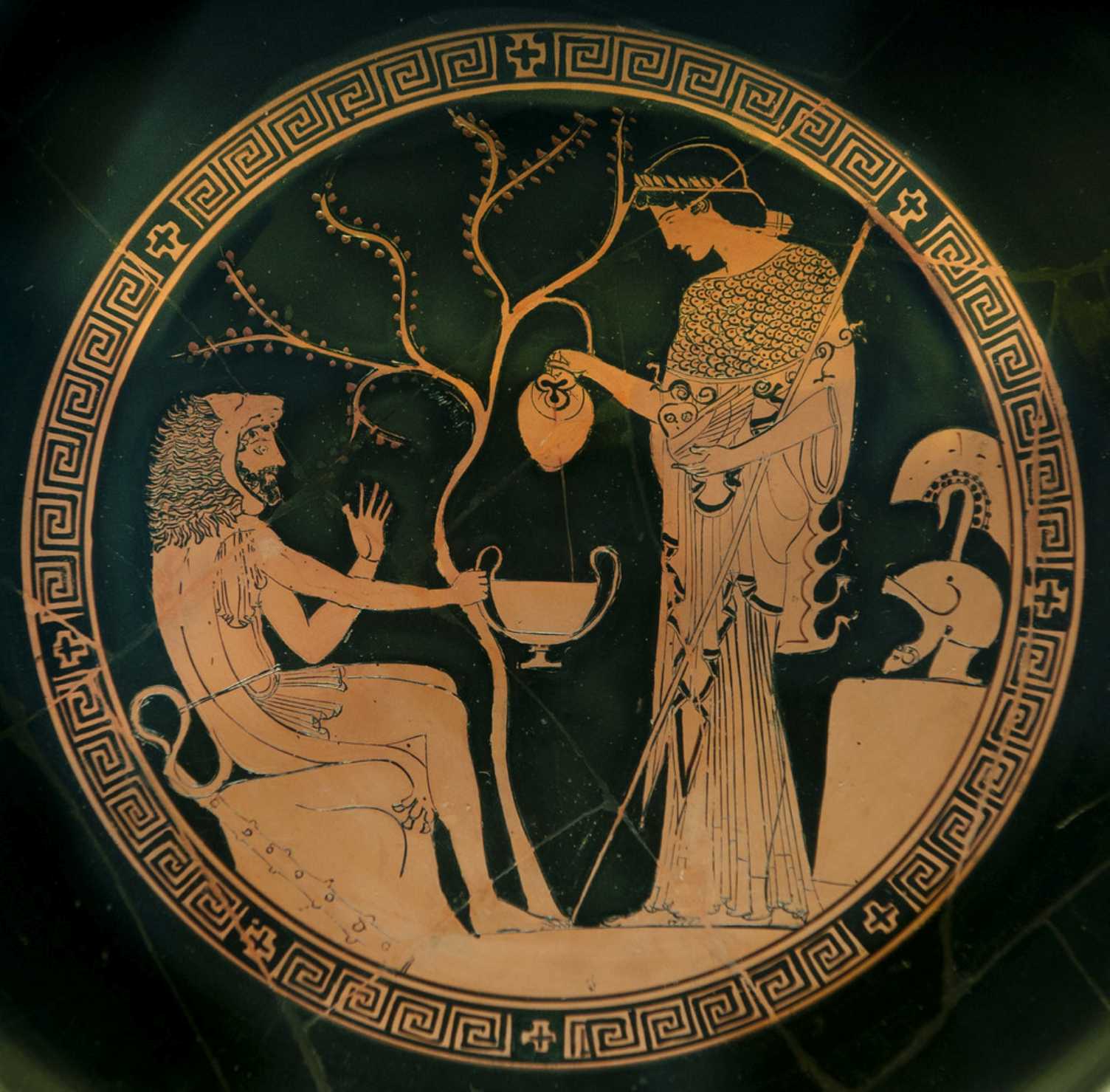
Image: Athena Refreshing Heracles (Munich Museum)
Hercules resting while Athena pours him a drink. He sits on a rock, wearing a lion skin over his head, and holds out a kantharos. He holds his left hand up, gesturing. Athena, standing before him, pours wine from a trefoil oinochoe. She wears a diadem and holds her owl in her left hand, while her spear rests in her arm and her helmet is set on a rock beside her. Behind the two, an olive tree.
Source: Mark Cartwright, ancient.eu, theculturetrip.com and agrovim.gr