
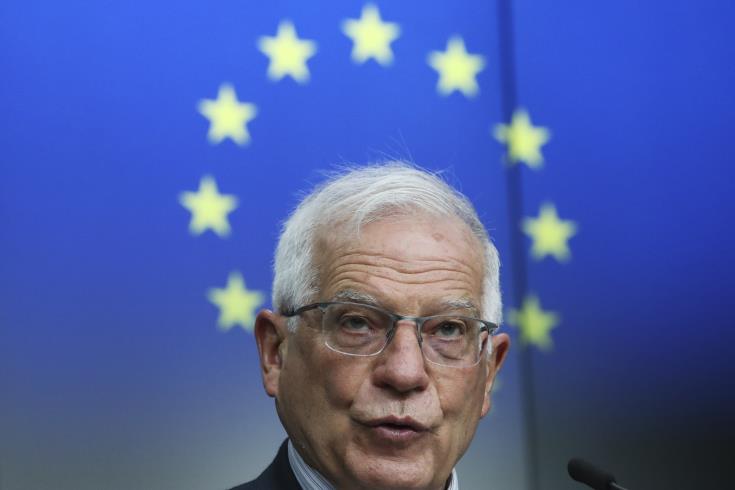

The sooner the EU becomes fully involved in the Cyprus talks, the better High Representative of the EU for Foreign Affairs and Security Policy / Vice-President of the European Commission Josep Borrell has said.
In a letter of reply to Chair of the Committee on Foreign Affairs in the European Parliament David McAllister that the Democratic Rally released on Sunday, Borrell welcomes the agreement reached in Geneva in April on another “5+UN” informal meeting, as announced by the UN Secretary General on 29 April, adding that EU continues to support fully the United Nations and ongoing efforts to create the best possible conditions for the next meeting.
“We stand ready to provide whatever assistance both Cypriot leaders and the UN would find useful. I have reassured UN Secretary-General Guterres of the EU’s and my own readiness to engage at a political level, cognizant of the sensitivities of the process that he is trying to steer to a successful outcome”, Borrell continues in the letter dated on the first of June.
He furthermore notes that a future settlement needs to comply with the EU acquis and safeguards, the integrity and decision-making responsibilities and processes of the EU.
“The EU is an observer to the formal Conference on Cyprus. For above-mentioned reasons, the sooner the EU becomes fully involved in the Cyprus talks, the better. We are making this point with Turkey and the Turkish Cypriots,” Borrell says.
He reminds, EU senior officials were present in Geneva in April for bilateral meetings and notes that the EU remain closely engaged with the UN and the parties to this effect.
Borrell furthermore says that he shares the assessment that the situation in Cyprus is unsustainable and increasingly worrying from both a Cypriot and an EU perspective, and because of its implications for regional stability and prosperity in the Eastern Mediterranean.
“As the European Council has reaffirmed repeatedly, the EU remains fully committed to a comprehensive settlement of the Cyprus problem in accordance with relevant UN Security Council Resolutions and in line with the EU acquis”, he points out.
However, Borrell notes that as he has discussed with both President Anastasiades and Turkish Cypriot leader Tatar, the solution to the Cyprus issue cannot come from outside and that responsibility for finding a solution lies first and foremost with the Cypriots themselves.
“We know it is going to be a complex process but during my conversations, I have been encouraged by the readiness of both President Anastasiades and Mr Tatar to engage with the UN in order to find a common ground on the way forward”, he adds.
He also welcomes the intention of the AFET Committee to organise an exchange of views on the status quo of the Cyprus question, and trust that our services will take this forward at the appropriate time.
In his letter to Borrell dated May 7, Chair of the Committee on Foreign Affairs of the European Parliament refers to the result of the Geneva meeting, pointing out that “whatever one thinks of the realistic prospects of this, the situation in Cyprus is increasingly worrying from an EU perspective”.
“While there are many issues at stake, the security dimension needs to be followed closely. The latest developments around hydrocarbons have illustrated that the Cyprus issue has the potential to destabilise the Eastern Mediterranean region. Moreover, as is well known, in economic terms, the Cyprus Problem is holding back the development of a viable energy infrastructure in the region, which also has a bearing on the energy architecture of the Union itself,” he adds.
He also stresses that any Cyprus settlement, if it is to happen, requires an active buy-in by both Cypriot communities, but also Turkey. “Unfortunately, recent developments in Turkey have further reduced the scope for any agreements. However, I am convinced that the EU should nonetheless seek solutions for the Cyprus question compatible with the EU acquis communautaire, and hence the earlier the EU is involved the better”.
McAllister adds that the challenging regional dynamics have demonstrated that the status quo on the island might no longer be stable.
“The EU rightly declares its strong support to a Cyprus settlement that is “Cyprus owned, and Cyprus led.” There can be no sustainable solution that is imposed from the outside. At the same time, the two communities have further diverged from each other since Crans Montana in 2017”, he says.
He furthermore notes, that he’s convinced that the EU should seek to take a more assertive role in the process, in line with the views of President Anastasiades, who has repeatedly requested a more active EU role.
Finally, he says that the AFET Committee considers it a priority to organise an exchange of views on the status quo of the Cyprus question, including especially the EU role as outlined above, in time before the possible reconvening of the 5+1 conference by the UN in June or July.
Cyprus has been divided since 1974, when Turkey invaded and occupied its northern third. Repeated rounds of UN-led peace talks have so far failed to yield results.
The 5+1 Informal Meeting that took place in Geneva, on April 27-29, has failed to find enough common ground to allow for the resumption of formal negotiations in relation to the settlement of the Cyprus problem.
UN Secretary – General, Antonio Guterres, has said that he will convene in the near future another meeting of the 5+1, the five plus the United Nations, again with the objective to move in the direction of reaching common ground to allow for formal negotiations to start.