
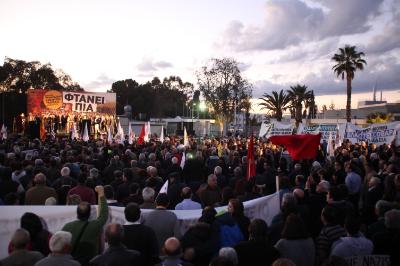

Thousands of protesters, according to the organisers, participated in a mass anti–austerity rally on Wednesday outside the Filoxenia conference centre in Nicosia, where the European Central Bank’s (ECB) council meeting will take place on Thursday.
The protest was organized by Trade Unions and Civil Organisations Platform “The society reacts and demands” and was attended by various trade unions and other organisations as well representatives of other European Trade Unions and Civil Organisations.
The protesters, members of some 19 organisations, held banners and chanted anti-austerity and anti-Troika slogans, calling for growth and the creation of new jobs, such as “Enough”, “Citizens against corruption”, “Save the people” and the “the Nazis are back”. Officials and members of AKEL, DIKO, EDEK, the Green Party and the Citizens’ Alliance as well as MEPs and members of parliament were also present at the rally.
Members of ‘The society reacts and demands’ handed to a representative of Draghi a petition asking for a policy of growth, development and new quality jobs and the termination of the reduction in the funding for social policy and dismantling of the welfare state.
The memo also asked for the immediate elaboration of progammes that will effectively combat poverty and social exclusion, transparency and democratisation in the decision making processes in the EU bodies, including the ECB, and end to the policy of privatisations and the selling off of public wealth and respect of labour relations, collective agreements and workers` rights.
It also outlined the fallout on the people of Cyprus of policies adopted and implemented by decision makers in Europe and at home. These include a reduction of Cyprus` gross domestic product, a huge rise in unemployment, migration of young people, the risk of having one`s house appropriated, massive salary cuts and thousands of people living on the poverty line.
Speakers who addressed the crowds said people gathered in Nicosia tonight to condemn policies followed by the Troika (ECB, EU Commission and IMF) which have caused huge problems and have forced hundreds of people to live in poverty.
The working class in Europe, they vouched, will continue its struggle to protect its rights at work and in society, they pointed out, adding that the working people are bearing the brunt of fiscal policies which have affected them deeply and led to unemployment, social exclusion, closing down of small businesses.
On Cyprus, they said that the country was under blatant blackmail and threats, led by the ECB and backed by the Cypriot government.
The Cypriot economy has been in recession since mid-2011 amid an unprecedented financial crisis, that escalated further with the bailout of the financial sector which reached the brink of collapse in March 2013.
The €10 billion bailout featured a haircut of banking deposits above €100,000 as well as capital restrictions that hampered economic activity.