
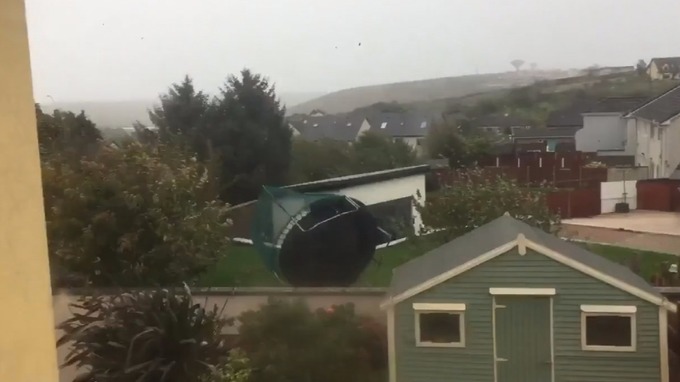

Three people have died in Ireland in incidents related to Storm Ophelia.
The violent weather has also left around 360,000 homes and businesses without power as the storm’s winds of more than 96mph (156kph) hit Ireland and western parts of the UK.
A woman, who was in her mid-50s, was killed when a tree fell on her car while she was driving in severe winds in a village near the southern city of Waterford.
Another woman, who is in her 70s, was injured in the crash, but her injuries were not said to be life-threatening.
A man in Ravensdale, Dundalk, was also killed when a tree fell on his car.
Another man, aged in his 30s, died in a chainsaw accident in Cahir, Co Tipperary when he was trying to clear a tree downed by the storm.
Gardai have urged people not to travel unless absolutely necessary, and around 130 flights have been cancelled at Dublin Airport.
While western parts of the UK have also been battered by the storm, Ireland has been hit with the worst of the weather, with Taoiseach Leo Varadkar urging people in Ireland to stay safe, saying: “The advice is: stay indoors until the storm passes.
“It is a very dangerous storm. The last time there was a storm this severe 11 lives were lost.”
ESB, the Republic of Ireland’s electricity network, warned that more outages were expected and that repairs would take several days.
Met Eireann has issued a “status red” weather alert for Galway, Mayo, Clare, Cork and Kerry, warning of severe winds and storms.
In the UK, around 16,000 homes in Northern Ireland have been left without power, while a further 200 homes in Wales experienced a loss of electricity.
Schools also closed early, trees have fallen into roads, and bridges have been shut as remnants of the hurricane battered the country’s west coast.
Further power outages are expected which could take several days to repair, energy suppliers have warned.
Winds of up to 80mph have hit the UK – exactly 30 years after the Great Storm of 1987, which killed 18 people.
A red sun spotted in the sky over parts of England on Monday is also due to Storm Ophelia.
The unusual occurrence was seen in areas including the midlands and south-west, and was caused by the former hurricane pulling air and dust up from southern Europe and Africa.
A yellow warning for high winds is in place for much of Wales, Scotland, north-east England, north-west England, south-west England and the West Midlands.
Parts of Scotland and Wales have been upgraded to amber.
Planes have been grounded in many of the affected areas and ferries have been
Although no longer classed as a hurricane, the Met Office issued a “potential risk to life and property” warning, while flood warnings are in place along the Pembrokeshire coast, parts of west Scotland, north-west England, Cornwall and Dorset.
The RNLI has warned people to stay away from the sea during the extreme weather.
Matt Crofts, lifesaving manager, said seas are “particularly dangerous and unpredictable, with large waves and swells being a major risk”.
“Stormy conditions may be tempting to watch but big waves can easily knock you off your feet,” he added.
“The sea is far more powerful than you think and your chances of survival are slim if you are dragged into the swell.
“Our volunteer lifeboat crews will always launch to rescue those in danger at sea, but to launch into conditions like these could also put their lives at risk.”
Motorists on the M77 in western Scotland faced lengthy tailbacks as a lorry blew over in high winds at 8.30am and blocked the southbound lane for more than a hour.
The storm is expected to move across Wales, northern England and Scotland throughout Monday and into Tuesday and will weaken as it goes.
“It will be gradually easing up into Scotland overnight and into Tuesday morning, it’s weakening as it goes,” Met weather forecaster Grahame Madge said.
“Parts of England, areas like the North West, are covered by a warning. The impacts will be felt in northern England into Tuesday.”
Tailbacks developed on the M77 heading into Glasgow after a lorry overturned in high winds.Credit: PA
The UK Ministry of Defence (MoD) has three battalions, 1,200 personnel in total, permanently on standby to assist with contingencies.
But an MoD spokesman said it has not yet received requests from any local authority for assistance.
“Atmospheric circumstances” linked to Storm Ophelia are also thought to have caused a number of flights to UK airports to be diverted after “smoke smells” were reported on board.
EasyJet said four of its flights were diverted due to “atmospheric circumstances” linked to Storm Ophelia, while a British Airways spokesperson said the carrier has had “some reports of smells on board” but the aircraft continued to their destinations.
An easyJet spokesperson said: “EasyJet can confirm that four of its flights flying in the west of the UK have reported smoke smells in the cockpit today, believed to be linked to atmospheric circumstances due to storm Ophelia…
“We understand other airlines have experienced similar events and we continue to liaise with the Met Office as to the likely cause.”
Irish forecasters have held a meeting of the National Emergency Coordination group in Dublin. Credit: PA
The Head of the Northern Ireland Civil Service, David Sterling, held an emergency meeting with the permanent secretaries from all government departments on Monday morning.
It was decided that all government buildings providing non-essential services close at 1pm and all non-essential civil service staff will leave work at that time.
Prime Minister Theresa May spoke to Mr Varadkar on Monday afternoon and “expressed her sympathies for the loss of life and said the UK Government stood ready to provide any support if requested” by Ireland, a Downing Street spokesperson said.
All schools in the Republic of Ireland and Northern Ireland will remain closed on Tuesday.
ITN