
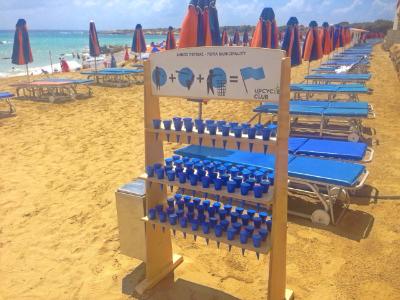

Peyia Municipality asked its visitors what most annoyed them and they said “cigarette butts”.
In a study carried out through social media, with an aim to protect the environment and promote sustainable tourism, Peyia Municipality requested feedback from its visitors and locals, who said the main problem of the area was pollution along the coastline, especially beaches littered with cigarette butts.
Executive Engineer for Peyia Municipality, Myria Loizidou, told CNA that the local authority has received many complaints about litter on the beach.
In an effort to solve the problem, the Municipality placed wooden stands on the beaches with instructions and recyclable plastic cones, which visitors use for collecting their cigarette butts and then empty the cones in a designated bin. At the end of the tourist season, the cigarette butts are gathered and weighed.
“Every wooden stand is equipped with 100 plastic cones, made from environmentally-friendly, recyclable material”, Loizidou said, noting that this initiative was the product of the Municipality`s environmental consciousness.
The Municipality’s efforts for recycling and protecting the environment do not stop here.
Loizidou told CNA that Peyia also participates in the Green Dot programme for recycling, and has placed recycling bins for paper, plastic and glass at various points.
Furthermore, one of the green points in the Paphos district has been set up in Peyia, where various recycling bins have been placed for the collection of 24 different kinds of materials.
The green point is open every day, except Tuesday and Thursday.
She explained that citizens can take anything to this green point and then these items, including rubble, aluminium, glass, furniture, thermometres, bulbs, metal objects, heaters, tiles, bathroom fittings, construction materials, batteries, wood, cleaning materials, carpets, paint, textiles, medicines, toys etc, are placed in containers and sent for recycling.
At the same time, Peyia Municipality is promoting reusing. Loizidou said any citizen can take an old bicycle or used furniture, which are stored separately at the green point, and – if in good condition – they can be reused.
She noted that prunings in large quantities are not received there, which causes problems for the local authority.
Loizidou pointed out that there is a huge volume of prunings in Peyia but unfortunately the green point cannot take large quantities due to its small size and thus cannot meet the needs of the citizens and companies.
Thus, for the time being, large quantities of prunings are taken to the landfill site in lorries, at a high cost for the local authority.
Furthermore, the shredder at the green point is small and cannot shred the bulk of prunings from Peyia.
Loizidou also said Peyia is a partner in FUPOL (Future Policy Modelling) research project, which is funded by the 7th Framework Programme of the EU.