
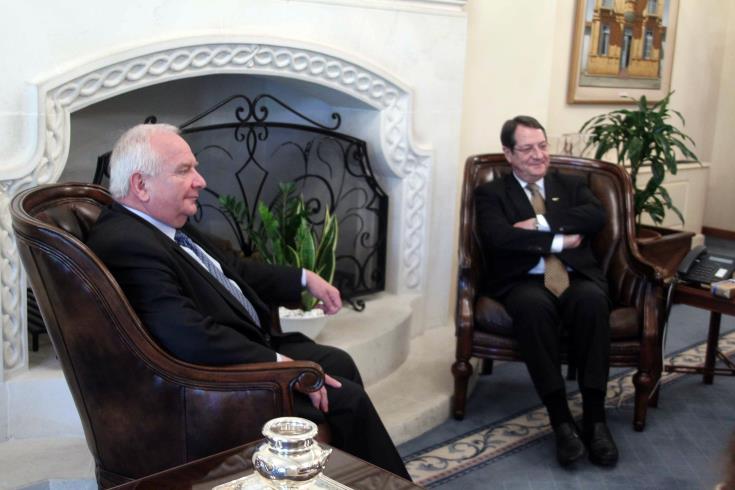

Turkey is not getting away with not recognising an EU member state, EPP President Joseph Daul has told CNA in an interview, pointing out that the resolution of the Cyprus problem stands between Turkey and its European aspirations.
Joseph Daul, the President of the European Peoples Party (EPP, the political family that includes both German CDU/CSU and Austrian APP) renews a call on Turkey “to facilitate a climate conducive to free negotiations, and to contribute concretely to the ongoing efforts for a settlement, including by withdrawing Turkish forces”, following intensive discussions in the framework of the EPP on Turkey`s future EU bid.
“Turkey is not getting away with not recognising an EU member state, Cyprus,” he stressed.
President Daul gave an exclusive interview to CNA, in the aftermath of months of internal discussions between the parties of the EPP political family on the future of EU – Turkish relations, the accession negotiations and potential future partnership, proposed by some of its members.
Joseph Daul, conveying only the already agreed positions of major EU EPP member governments, clearly explains that the resolution of the Cyprus issue stands between Turkey and its European aspirations. He also stressed that Turkey, at this stage, does not meet the criteria for becoming an EU member.
More specifically, invited by CNA to say who was responsible for the collapse of the Cyprus peace talks last July, President Daul explains that “the failure to reach a comprehensive settlement at the Crans Montana Conference was a disappointment. We reiterate our support to the process for a comprehensive and viable settlement of the Cyprus issue, in accordance with relevant UN Security Council resolutions and fully in line with EU law. Peace and stability in the region are at stake. It is also about the well-being of the Cypriot people and the island’s economic development.”
“Pointing fingers is not very constructive. Instead, I, and all EPP leaders, prefer to commend President Nicos Anastasiades whose dedication and commitment have gone a long way to move the negotiations forward. If there is any chance of concluding the talks, Nicos Anastasiades must be sitting at the table. I am convinced the Cypriot people will entrust him again on 28 January”, he says and clarifies that “on the other side, we call on Turkey to facilitate a climate conducive to free negotiations, and to contribute concretely to the ongoing efforts for a settlement, including by withdrawing Turkish forces”.
Asked how Turkey can get away with not recognising an EU member state, he said “Turkey is not getting away with anything. EU accession negotiations with Turkey have not been moving forward. Cooperation with Turkey is important in a number of areas, notably migration, the fight against terrorism and trade. But the interests of all 28 EU Member States, in particular Cyprus, must be respected and protected, the EPP line is very clear on this point”.
Called to present the ideas floating by EPP members (Austria) on some other form of partnership (other than full membership), he responds: “Let’s look at the facts. In 2005, the formal EU accession negotiations began. But until Turkey agrees to apply the Additional Protocol of the Ankara Association Agreement to Cyprus, eight negotiation chapters will not be opened and no chapter will be provisionally closed.”
“We owe clarity to the European citizens and to the Turkish citizens on the relations between the EU and Turkey and it will be an important topic for the EPP ahead of the 2019 European elections. At this stage, Turkey does not fulfill the criteria to be part of the European Union. These are the facts”, he stresses.
On the potential of an EU upgrade of the customs union with Turkey, he had this to say: “The EU’s Customs Union agreement is more than 20 years old and it might be time to update it. The EU is an important trade partner for Turkey and vice-versa: the EU is the first commercial partner of Ankara and Turkey is the EU’s fourth export market”.
Turning on the much-heated debate on the future of Europe and the rising waves of populism ahead of the 2019 European elections, President Daul says that “the best way to overcome the waves of populism is to bring concrete results to the European citizens. We need to act where we can make a difference for the Europeans.”
“Each euro spent must improve the lives of the European people. That’s what the EPP is doing every day: from security and defence, with the establishment of the Defence Fund and closer cooperation within EU countries, the protection of EU’s external borders, the economic recovery, to a Social Europe with policies that prepare the EU citizens for the challenges of a globalised world and a digital society”, he explains, warning at the same time that “a new danger has arisen: the populists moved from false promises to fake news”.
“We will have to be extremely vigilant during the European elections. Look at what happened with Nigel Farage during the Brexit Campaign. We need to double our efforts to explain the benefits of the European Union. Our institutions are strong enough to hold the populists’ attacks but it must not prevent us from protecting them. On the contrary”, Joseph Daul has told CNA.
Asked whether EU Institutions also had some responsibility in the rise of populism with their handling of the financial crisis he says: “the handling of the financial crisis showed great solidarity among Member States. One should not forget that. This solidarity made possible to protect the savings of people, while in Iceland people lost everything. The EU has all along done what was necessary to ensure a better future of all European people. This solidarity was combined with responsibility. Difficult, sometimes even harsh, decisions were taken but always keeping in mind the well-being of the European citizens.”
He also stresses that “taking hard measures in times of crisis shows true leadership. While the populists played and continue to play on the fears of the people, the EPP provided answers and results.”
“The efforts of the European people were not in vain as the EU’s economy is bouncing back. A growing economy means jobs, stability and the possibility to prepare for the rainy days. The unemployment rate is at its lowest since the beginning of the crisis, 8.7% in the eurozone and 7.3% in the EU. Nearly 9 million jobs have been created since Juncker took office. It is a matter of time for the people to feel it in their wallets,” he stated.
Finally called to explain why Greece is still under a bailout deal, while Cyprus succeeded earlier on, he notes that “Both countries were severely hit by the financial crisis and both Greeks and Cypriots made a lot of sacrifices. Why is Cyprus on the recovery path while Greece is trailing behind? It is simple, let’s look at who is at the helm of the country. Nicos Anastasiades’ government undertook difficult but necessary reforms to save the island’s economy and guarantee the future of the Cypriot people. Nicos Anastasiades is a reliable European partner bringing trust to the Cyprus economy. We can always count on President Anastasiades, who participates in the EPP Summits. Cyprus Finance Minister Georgiades is also very active in the EPP Finance Ministerial meetings and does a fantastic job. In Greece, the pace of reforms has been very slow due to Prime Minister Tsipras’ political games that jeopardise the efforts of the Greek people.”