

A Turkish Cypriot candidate won for the first time a seat in this week’s European parliament elections in what is already being hailed a watershed moment for the partitioned island.
In a country riven physically and psychologically by ethnic division, polls showed widespread support for Niyazi Kızılyürek, a prominent Turkish Cypriot academic who was fielded by Akel, the main opposition leftist party in the Greek-controlled south.
“It will be a watershed in the modern history of Cyprus,” said Hubert Faustmann, professor of political science at the University of Nicosia. “No Turkish Cypriot has held elected office in the Greek Cypriot-dominated republic since the breakdown of the constitutional order in 1963. It’s hugely symbolic that for the first time the Turkish Cypriot community will feel that they have a voice in an international forum.”
Akel’s decision to include Kızılyürek on its ballot was met with delight by pro-reunification supporters on both sides of the Mediterranean island’s ethnic divide. Nearly two years after settlement talks collapsed in Switzerland, the quest for a solution to the west’s longest-running diplomatic dispute remains frustratingly elusive.
For many, its appeal is a reminder of the dangers inherent in failing to unite Cyprus, where ethnic Greeks and Turks have been segregated behind a UN buffer zone since an abortive attempt at annexation with Greece prompted Ankara to invade and seize the island’s north in 1974.
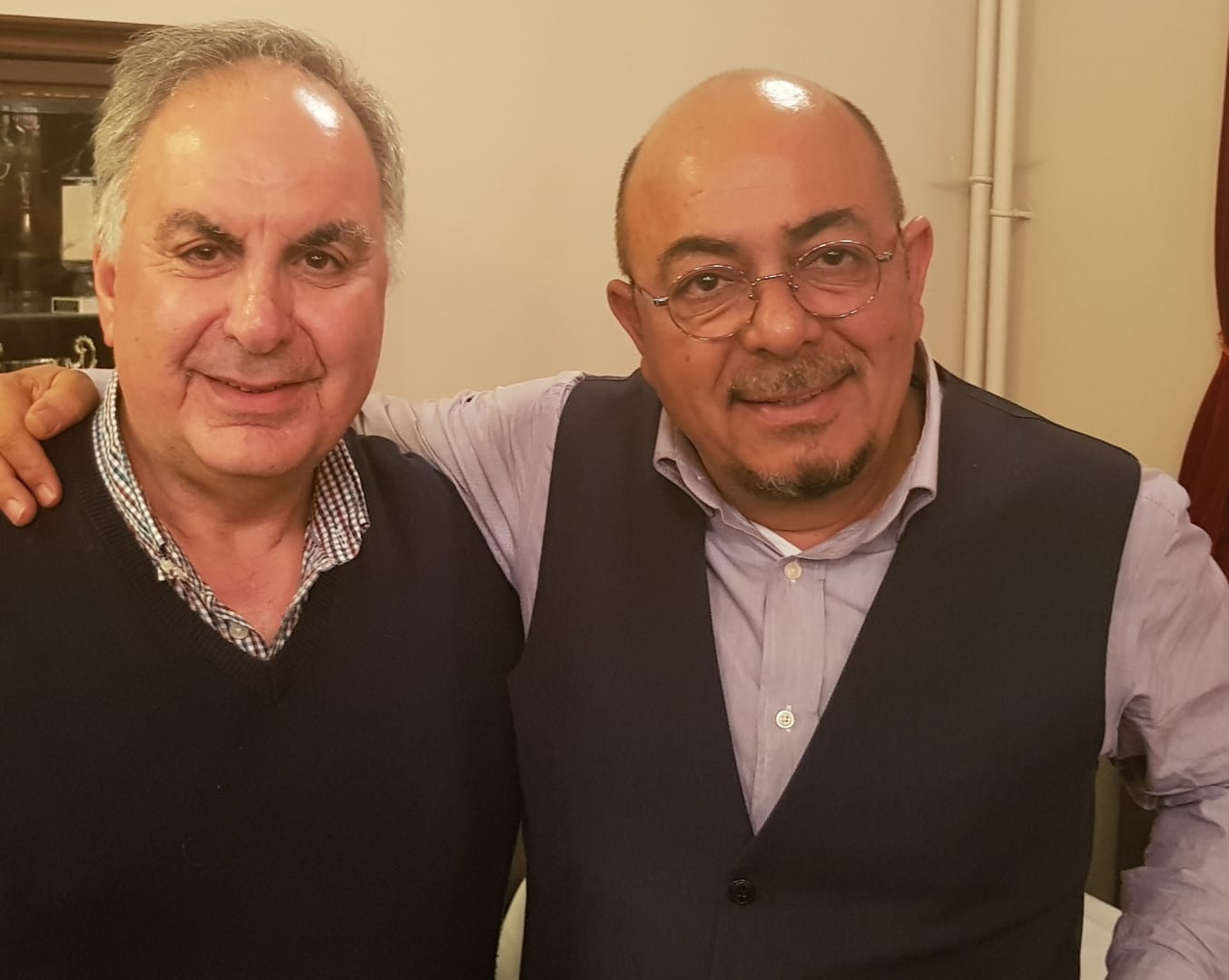
Kızılyürek seen here with our Michael Yiakoumi is a staunch advocate of reunifying the country’s two feuding communities in a bi-zonal, bi-communal federation. And as the only Euro MP candidate who was canvassing on both sides of the divide, he took his campaign from Paphos in the south to the Karpaz peninsula in the north.
“The European Union is a peace project,” said the 59-year-old, who lives in the south where he teaches at the University of Cyprus. “My main objective is rapprochement. I am going into this not on the basis of ethnic background but on the basis of my ideas,” he told the Guardian. “Yes, I am Turkish Cypriot, yes I am Cypriot, but above all I am a federalist.”
For progressives, the polyglot professor is the embodiment of the values Europe so badly needs. Fluent in English, German and French, as well as Turkish and Greek, his enthusiasm for the EU is regarded as the antithesis of the policies espoused by Eurosceptic populists bent on breaking up the bloc.
“Turkish Cypriots are really excited that a Greek Cypriot party has taken the unprecedented step of putting a Turkish Cypriot on its list but also because in some sense they are a meeting point,” said Sami Özuslu, who heads the Journalists’ Association in the rump state.
“For the first time peace supporters on both sides are working and campaigning together.”
Since acceding to the EU in 2004, Cyprus has been designated six seats in the European parliament. In theory, two of them are reserved for Turkish Cypriots, who represented 18% of the island’s population at the time of the invasion. But with EU law suspended in the unrecognised north, only Greek Cypriots have ever represented the island in Strasbourg.
Who is Niyazi Kizilyurek
Niyazi Kızılyürek (born 1959 is a Turkish Cypriot political scientist. He is, as of 2016, a professor of political history in the University of Cyprus, specialising on the political history of Turkey and Cyprus, and the Dean of the School of Humanities there.
Biography
Born in Potamia, he fled to Louroujina along with his family due to the intercommunal violence of 1964. After completing high school in Northern Cyprus, he went to University of Bremen, where he graduated with a BA and MA in Sociology, Politics and Economics in 1983. He completed his PhD at the same university, with a thesis on the Cyprus dispute.
He produced a documentary called Our Wall with Panicos Chrysanthou, later winning the Apdi İpekçi Peace Award for the documentary in 1997. In 1995, he entered the University of Cyprus as a lecturer. Upon his entry, he was targeted by fascists, nationalist politicians and media, facing a year-long campaign for his expulsion from the university. He resisted with the support of his co-workers and the university and remained there. He related that over the years, the working environment became much less hostile. In 2013, he was elected Dean of the School of Humanities. In 2014, Kızılyürek became one of the advisers of President Nicos Anastasiades on Turkey in the Geostrategic Advisory Council.
Kızılyürek has authored around 20 books, including Glafkos Clerides: The Path of a Country. He is a columnist in the Turkish Cypriot left-wing newspaper Yeni Düzen and the right-wing Greek Cypriot newspaper Simerini. He commands five languages, Turkish, Greek, English, German and French.
Politics
Kızılyürek entered politics in 2019, as a candidate for the 2019 European Parliament election with the left-wing Progressive Party of Working People (AKEL). His candidacy has proved controversial; according to critics, it only serves to reward Turkish intransigence and to normalize the presence of the occupying Turkish Army in Cyprus.
He was elected to the European Parliament with 25.051 votes, coming second among AKEL’s candidates, behind Giorgos Georgiou. His election led to renewed controversy, with critics questioning his loyalty to the Cyprus Republic, because he said that he will represent the Turkish Cypriot community (and not Cyprus as a whole) and that he will promote the turkish language as an official language of the European Parliament (because it is an official language of the Republic of Cyprus).
On the other hand, his supporters have repeatedly praised Kızılyürek’s positions about a peaceful reunification of Cyprus and his explicit condemnation of the Turkish invasion and military occupation, as well as the ethnic cleansing and theft of property committed against Greek Cypriots since 1974.