
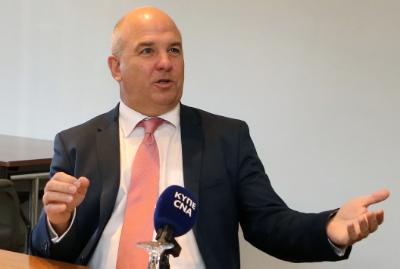

Nils Muižnieks, the Council of Europe Commissioner for Human Rights, has expressed regret over the refusal of the UK government to resettle 67 refugees and asylum seekers, stranded for almost 18 years in the British Bases, in Cyprus.
In an interview with the Cyprus News Agency, Muižnieks says he understands London`s reservations, which does not want to signal the opening of a potential route to the UK for migrants and smugglers, however he urges the British government to reconsider the cases, saying that all concerns have been addressed by a 2003 Cyprus-UK agreement.
The Commissioner welcomes Cyprus` participation in the EU emergency relocation scheme aiming to address the refugee crisis and calls on authorities to examine all asylum applications on an individual basis, even though the majority of the applicants enters from the northern Turkish-occupied part of the island.
Moreover, he says that the government should measure the impact of its austerity measures and calls for the creation of “social safety nets” for the most vulnerable.
On missing persons, he says that more efforts are needed in Cyprus to disclose the truth, and takes note of the important work that is being carried out by the Committee on Missing Persons (CMP).
Muižnieks, who presented on Thursday his latest report on Cyprus, talked to CNA and said that there are certain positive developments regarding asylum in Cyprus, such as the recent increase in the level of international protection recognition.
He expresses concern, however, and emphasizes that the bulk of positive decisions by the Asylum Service grant subsidiary protection rather than refugee status to asylum seekers, including those from Syria.
This, he points out, prevents beneficiaries from enjoying the right to family reunification.
The list of concerns includes the widespread use of migrant detention, the lack of access to legal assistance and the lack of long-term integration policies.
In his report, the Commissioner notes that 90% of asylum seekers in 2014 have entered Cyprus from the northern, Turkish-occupied part of the island. Despite the additional burden, he says that the state concerned – in this case the Republic of Cyprus – has the obligation to carefully and individually examine all asylum applications, including those submitted by asylum seekers entering from the northern part of the island.
Asked if, at times of dire financial straits, the human rights impact assessment of austerity policies, which the Commissioner recommends, is incompatible with the general effort towards recovery, Muižnieks notes that “on the contrary, the assessment can help a country saves money without undermining vital sectors” such as health, education or police.
There is a minimum level of social rights protection that should always be preserved, he goes on, and points to effective access to medical care.
He further encourages the creation of social safety nets for the most socially vulnerable groups of the population, in the form of cash transfers, transfers in kind, income support or fee waivers for essential services and says these should form part of the national social protection systems.
“The guaranteed minimum income (GMI) scheme introduced by the Cypriot authorities is part of the solution” he adds and underlines the need to protect the vulnerable.
Asked about missing persons and what can be done to address this humanitarian issue, the Commissioner notes that the passage of time makes it harder to identify the remains of victims, and increases the suffering of their families.
He adds that with respect to Cyprus “many efforts were made by both sides in recent months” but “more efforts are needed and everything should be done by all sides to finally disclose the truth and provide reparation to victims’ families”.
The CMP in Cyprus does a very good and very important work, Muižnieks notes and says that it should be further supported with more resources.
“I hope that progress made so far in the peace negotiations will have a positive impact on and improve the effectiveness and efficiency of the work of CMP” he says.
The Human Rights Commissioner is about to travel to Turkey, where concerns over media freedom have recently put the country in the spotlight. He tells CNA that it is necessary to “ensure a pluralist, free and safe media in that country”, ahead of his meetings there with journalists and authorities. A report with recommendations will follow at the end of his visit.
Asylum seekers in British bases
—————————————-
Last January, the Commissioner asked the UK authorities to “examine favorably” the cases of 67 refugees and asylum seekers – mainly Kurds from Iraq, Syria and Iran, who landed in 1998 in the British Base in Akrotiri, and remain in Cyprus for almost 18 years. All are suffering from “serious psychological problems, including severe depression” according to a psychological assessment.
“I understand the reservations and caution that has been shown so far by the UK authorities that do not wish to give any signal to migrants and smugglers” to turn the Bases areas into a route to reach the UK, the Commissioner said.
He added, however, that “such concerns should be put to rest by the fact that the provisions of the Memorandum of Understanding, signed by the UK and Cyprus, have addressed and resolved such issues in a definitive manner for arrivals post-2003”.
He urges the UK government to reconsider its refusal to resettle the 67 people and hopes that a fair and durable solution will soon be provided by the UK, or eventually Cyprus.
Britain, a former colonial power, has retained two military bases in Cyprus since the island gained its independence in 1960 after a four-year anti-colonial struggle.