
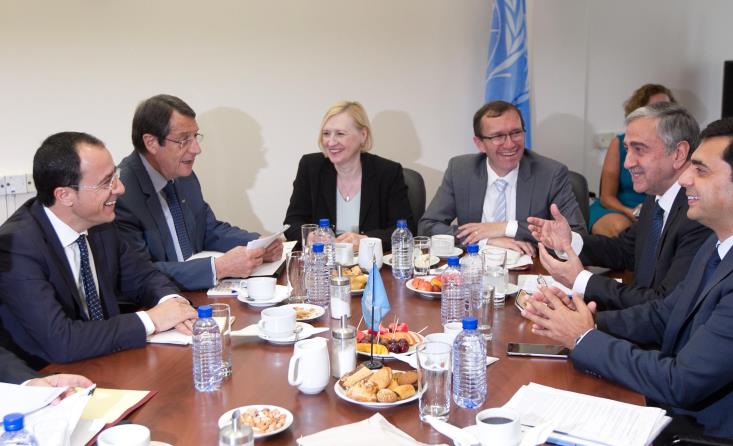

In his Good Offices report, UN Secretary General Ban Ki-moon sees clear progress on a wide range of issues in the negotiations between the Greek Cypriot and the Turkish Cypriot leaders, while at the same time, he points out that there is still much work that remains ahead.
An advanced copy of the 9 page report covering developments from 22 December 2015 to 30 June 2016 was submitted to the Security Council members on Friday evening.
The SG calls on the leaders of the island’s two communities, Cyprus President Nicos Anastasiades and Turkish Cypriot leader Mustafa Akinci, as they tackle key outstanding issues, to do their utmost to translate the significant mutual understandings they have reached in the course of the year of negotiations into concrete convergences.
“To achieve this, they will need to sustain their ongoing dedication and leadership, as well as a structured approach which would allow them to conclude deliberations on the issues they have identified for the intensified phase,” Ban says.
Secretary Ban mentions and welcomes in at least four chapters of his Good Offices Mission report the leaders’ statement of 15 May 2016, in which they underlined their commitment to intensify their efforts in the coming months with the aim of reaching a comprehensive settlement agreement within 2016. Although he clarifies that this is not a timetable, he urges the leaders to grasp the opportunity and reach a settlement.
“The commitment expressed by the leaders in their statement of 15 May 2016 to intensify efforts is a clear indication that, while the UN has no time-lines for the process, the sides recognize that there is a unique opportunity for these negotiations to reach a positive conclusion. I strongly urge the leaders and their teams to use the coming weeks and their ongoing intensified work to make further progress as promptly as possible. This is all the more critical if they are to grasp the opportunity to move closer to their stated aim of reaching an agreement within 2016.”
He describes the opportunity in front of the sides to bring the process to a successful outcome as “real and historic, but yet fleeting and fragile” and he remains convinced that a mutually acceptable solution to this long- standing issue can be found and that it is, today more than ever, within reach.
This, however, he points out, “will require both sides to act with determination, to take timely and courageous decisions and, most importantly, to look beyond the immediate present as they work together to build a common future for the island, where all Cypriots will be able to prosper in peace and mutual respect.”
He shows encouragement for the determination and political will that have been displayed by the leaders, saying that they have repeatedly shown that, while each negotiates in the interests of his own community, they are also able to take into consideration the concerns of the other community, in order to reach a settlement that meets the best interests of all citizens of a future, united Cyprus.
Ban Ki-moon acknowledges that while the ability and willingness of the leaders to reach mutual understandings has been a positive development, it has also proved difficult at times to translate such understandings into more detailed provisions and convergences on specific issues.
“I am therefore encouraged by the decision of the leaders to intensify their ongoing direct negotiations as well as to continue providing detailed guidance to their negotiators, in order to actively find solutions to long-standing divergences,” he notes.
One of the challenges of the negotiations he mentions are the necessary preparations for the implementation of a settlement, particularly in areas such as preparations for the extension of the euro currency in the future Turkish Cypriot constituent state and, more broadly, for the implementation of the EU acquis communautaire.
He welcomes the important work carried out in the framework of the Bi-communal Ad Hoc Committee on EU preparations and he urges the sides to maintain their efforts to ensure all necessary measures are taken in a timely manner to make possible a smooth and successful transition following the settlement agreement.
The SG stresses the importance of the close cooperation amongst the international financial institutions under the UN auspices noting that the two leaders need to utilize the technical assistance and support to the negotiations by the European Commission, European Central Bank, the International Monetary Fund and the World Bank, in order to jointly design an economically sustainable agreement that maximizes an expected peace dividend.
“An important and sensitive period lies ahead, as the institutions working in support of my team in Cyprus complete diagnostic work on the current economic situation in both communities and conclusions and policy recommendations are formulated and communicated to the two leaders and their teams.”
He also reveals that his Special Advisor Espen Barth Eide is often in teleconference with representatives of these institutions and he urges the two leaders to incorporate the advice and best practice guidance into their discussions, in order to better structure the post-settlement federal system.
“It is now of critical importance to incorporate this work into the talks to ensure that policy choices are made that will lead to an economically and fiscally viable post- settlement Cyprus. My Special Adviser and his team continue to engage in a substantial coordination effort to assist the sides in translating external economic advice into viable and politically palatable settlement provisions.”
While he welcomes the decision of the leaders to set up various expert working groups to deal with specific legal issues, he is strongly encouraging the two sides to move forward with these important expert-level discussions, “in particular those on constitution drafting”. He is also reiterating that Special Adviser Eide and his team stand ready to facilitate and support this work with expert advice.
He calls as “imperative” and “in line with the leaders’ stated aim to intensify efforts to reach a comprehensive settlement within 2016”, not to delay efforts to prepare both communities for the eventuality of a settlement. And he encourages the leaders “to strengthen their efforts to communicate jointly to the public through coordinated messaging.”
Given the turbulent events and challenges in the region and beyond, the Secretary General stresses the positive effects that a solution to the Cyprus problem would have, from a regional perspective, both politically and economically.
In this context, he says, it is vital that the guarantor powers, Greece, Turkey and the United Kingdom, remain committed to supporting the ongoing efforts of the leaders to reach a comprehensive settlement as soon as possible.
Ban says that he has consistently kept the resolution of the Cyprus question high on the agenda of the United Nations, as well as on the agenda of key regional and international leaders and he has discussed it with various Heads of State and senior officials, including from Turkey, Greece and the U.S.
In light of the leaders’ agreement to begin discussions on issues related to planning for the implementation of the settlement, including the possible challenges and the necessary preparations that will be required in various areas of the agreement, the Secretary Genera “urges the leaders to engage in earnest on all aspects of this important work-stream.” He also underlines the importance that “this work be conducted in coordination and cooperation with the ongoing planning being carried out by the United Nations in order to address the issues related to transition planning highlighted in my report on the United Nations Operation in Cyprus”.
A large part of the report involves the role and the contribution of the EU to the process. He notes that in late January 2016, the leaders agreed to embark on four technical ‘workstreams’ in support of the negotiations: preparation for rollout of the EU acquis island-wide post settlement, work with the international financial institutions, drafting of the constitution and federal laws and planning for implementation.
Despite the fact that work on the first two is progressing, he notes that “drafting of the constitution and planning for implementation have yet to begin in earnest.”
“A significant feature of the current round of talks has been the recognition by the leaders of the importance of having the principles and values upon which the European Union is founded upheld and embedded in the comprehensive settlement, whilst respecting its bi-zonal and bi-communal character”, the report notes.
Reporting on the developments following the leaders’ joint statement of May 15, 2016 and the statement of June 8 in which they announced their agreement to intensify the negotiations and to start working to resolve the remaining outstanding issues in an agreed structured manner, the Secretary General describes the chapters discussed.
“In particular, building on the framework set out in the Joint Declaration of 11 February 2014, as well as on work conducted by their negotiators over the past months, the leaders reached additional convergences on the list of federal competences and further clarifications on issues related to treaty making powers and coordination and cooperation between the future federal government and the constituent states.”
On the property issue, he notes that, taking into consideration the framework announced on 27 July 2015, in which the leaders agreed that the individual’s right to property would be respected and that there would be different alternatives for the regulation of the exercise of this right, “the sides initially held the negotiations on property on the basis of their respective position papers and materials. Following detailed, serious and at times difficult discussions, the sides were able to formulate a joint paper on property. While divergences remain and are recorded in the joint paper, it is important to note that this is the first time in the talks that the sides negotiate this critical chapter on the basis of a joint document.”
The talks have been focused particularly on issues such as the categories of affected properties, definitions, criteria as well as composition and functioning of the Property Commission which will be mandated to resolve property claims.
“Notwithstanding the rich discussions and important understandings reached on this chapter, further work will be needed in the crucial weeks ahead to iron out the remaining divergences”, Ban said.
Finally, on the issue of security and guarantees, the SG reports that, during the first months of the current round of talks in 2015, the leaders held initial discussions on internal aspects of security, “namely, policing arrangements for a united federal Cyprus. Some divergences on this topic remain and, on 8 June, the leaders agreed to include it as one of the issues to be addressed during their intensified efforts.”
Cyprus has been divided since the 1974 Turkish invasion. The latest round of UN-led peace talks is currently underway to find a negotiated settlement that would reunite the country under a federal roof.
Apostolid Zoupaniotis