

UNSG`s UNFICYP Report was circulated as an official UN document on Friday, 13 January.
The Report covers developments from 25 June 2016 to 15 December 2016. The SG asks for the Security Council to renew UNFICYP`s mandade for six more months, until the 31st of July 2017.
UNSG notes in his report, an `unprecedented progress` has been made in the Cyprus talks over the past nineteen months.
It notes that during the reporting period, and through their intensive work `in this leader-led process` the two leaders (President of Cyprus Nicos Anastasiades and Turkish Cypriot leader Mustafa Akinci) `succeeded in taking the talks further than they have ever been since 2008, achieving major progress in four of the six negotiation chapters – governance and power-sharing, property, the economy, and EU related matters. They also, for the first time, conducted negotiations on the issue of territory in Mont Pèlerin, Switzerland, which I opened on 7 November 2016`.
It adds that `unprecedented progress has been made in the leader-led negotiation process over the past nineteen months`.
The UNSG commends the two leaders for their efforts, adding that through their vision, courage and leadership they have advanced the talks in a definitive manner.
At the same time, he notes that a number of delicate and important issues remain and that since the process has now reached a critical juncture, he encourages the leaders to build on the momentum as they embark on the most crucial and perhaps most demanding part of their common journey.
“I also encourage all Cypriots to support the leaders as they move into the decisive weeks ahead, in pursuit of the common goal of reaching a comprehensive settlement as soon as possible. As the talks enter into a pivotal stage, it is more important than ever that the guarantor powers, Greece, Turkey and the United Kingdom, and other relevant actors remain committed to supporting the ongoing and determined efforts of the leaders”.
He also commends “the growing efforts” demonstrated by citizens’ groups in Cyprus to build support for the settlement talks and reunification.
Referring to the Committee on Missing Persons, the UNSG says that the UN remains committed to supporting the vital humanitarian work being carried out on behalf of the families of victims through the CMP.
He stresses that in the light of the advanced age of both relatives and witnesses, it is critical that the CMP be given the means and the information required to accelerate its work.
`In that respect, I am heartened to see that the resources of the CMP have been enhanced during this reporting period. This additional capacity is particularly important in light of the advanced age of many of the witnesses and relatives. The CMP’s efforts to heal the wounds of the past are not only critical for those families directly affected by the tragedy of the missing, but they also support the broader process of reconciliation between communities` he underlines.
Regarding the mine fields, he says that while the progress made towards the safety of Cypriots via the clearance of five minefields in the north is welcome, much more remains to be done and notes that the lack of action on the clearance of the minefield adjacent to the ceasefire line near Mammari, for example, continues to pose unnecessary risks.
Calling for all restrictions on freedom of worship, including restrictions on access to religious sites, to be lifted, the UNSG notes that joint efforts by the religious leaders continue to lend much needed and broad based support for freedom of worship and the peace.
He also calls upon both communities to exert efforts to create a climate conducive to achieving greater economic and social parity between the two sides and to widen and deepen economic, social, cultural, sporting or similar ties and contacts, including with a view to encouraging trade.
`Such contacts promote trust between the communities and help to address the Turkish Cypriots’ concerns regarding isolation. I urge both leaders to persist in addressing those issues`.
He urges the sides to formally accept the aide-memoire of 1989, `without which there is repeated contestation of the UN’s delineation of the ceasefire lines. In the same vein, I call on both sides to support UNFICYP’s role in preempting and responding to civilian, law and order and military-related issues, and in encouraging inter-communal activities to rebuild trust and cooperation`.
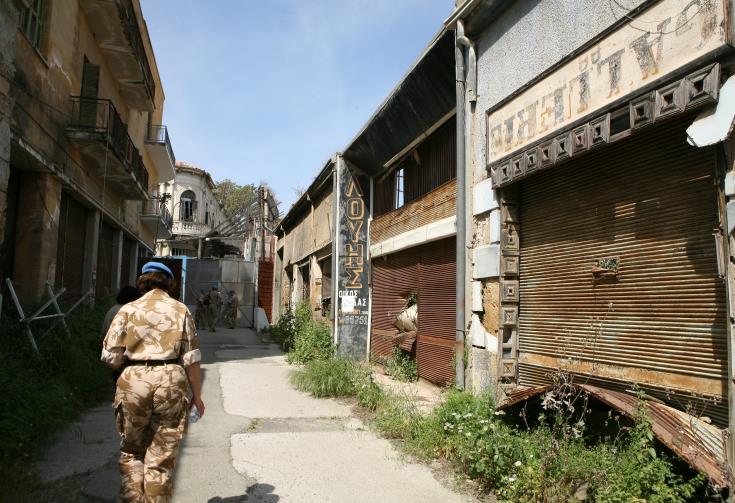
The UNSG encourages steps toward a permanent reduction in the military presence and posture along the ceasefire line, starting in those positions that have been enhanced with closed-circuit television cameras, particularly in the militarized area within the Venetian walls of old town of Nicosia.
He also notes that UN continues to hold the Government of Turkey responsible for the status quo in Varosha.
The UNSG welcomes the initial steps taken by the sides to engage with UNFICYP and his Good Offices Mission on transition planning, pursuant to Security Council Resolution 2300 (2016) adding that the establishment of a dedicated working group under the auspices of UNFICYP to deepen this work, together with inputs from the sides, is timely.
Such planning, he adds, will depend on further progress in the negotiations and on the deliberations of the sides regarding a UN support role in a reunified Cyprus.
`I underline the importance of UNFICYP, and any follow-on mission, being ready to respond to challenges both in the lead-up to, and following, the referenda. I hope to report back to the Council in due course on further developments on this matter` he says.
He points out that on 22 July, UNFICYP briefed the leaders on initial transition planning. In early November, the negotiators returned to such matters, in the presence of his Special Adviser and his Special Representative, and agreed in principle that the United Nations would focus on several key areas of support in a post-settlement period. Further discussion with the negotiators took place on 15 December.
The UNSG says that transition planning undertaken during the past year has demonstrated the extent to which the United Nations capabilities on the island will need to change in order to effectively support implementation of an agreement and assist the sides with the challenges of a post-settlement period.
Defining these new capabilities, he adds, will depend on further progress in the talks on key outstanding issues and will require thorough engagement with the sides on their expectations for the future UN role.
`It should be noted, however, that with current resources and in its present configuration, UNFICYP has limited ability to deliver appropriate support to a settlement. Moreover, such planning is but one aspect of a much broader need for preparations for implementation of a settlement that is the responsibility of the sides` the report notes.
President of Cyprus Nicos Anastasiades and Turkish Cypriot leader Mustafa Akinci have been engaged in UN-backed talks aiming to solve the problem of Cyprus since May 2015. Between 9th to the 11th of January 2017 the held talks in Geneva, followed by the Conference on Cyprus on January 12. Participants in the Conference on Cyprus decided to establish a working group at the level of deputies with the task to identify specific questions on security and guarantees and the instruments needed to address them.
The Republic of Cyprus has been divided since 1974, when Turkish troops invaded and still occupy 37% of its territory.
Every six months, the Secretary-General issues a report to the Security Council in which he discusses the situation in Cyprus and makes recommendations for the mission. This report forms the basis for the discussions in the Security Council and for the Council resolution. The Secretary-General also issues separate reports to the Council if a so-called Good Offices Mission is actively involved in negotiations seeking an end to the Cyprus conflict.