
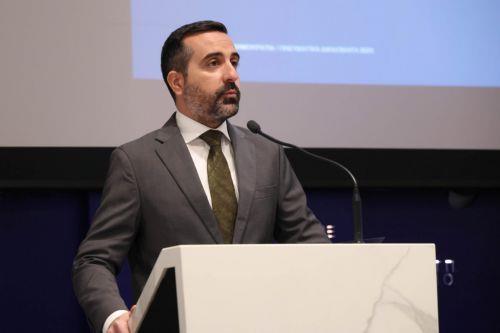

Our goal is to turn migration from a problem to a solution that benefits our citizens and the state, while always respecting our international obligations, Deputy Minister of Migration and International Protection, Nicholas Ioannides said on Saturday, speaking at a conference, at the Aristotle University of Thessaloniki, in Greece, entitled “The Republic of Cyprus and the European Union: Challenges and Achievements.”
Speaking specifically about the EU Pact on Migration and Asylum, Ioannides said that the Republic of Cyprus considers the Pact to be of fundamental importance for the European continent, as it strengthens the management of the Union’s external borders, since only those entitled to international protection and those arriving with valid work permits will enter the Union’s territory, rather than those illegally trafficked by smugglers.
He added that the Pact provides for faster and more effective asylum procedures, with states required to be able to examine applications quickly, fairly, and reliably, while, at the same time, respect for European and international law and fundamental rights remains at the core of the new framework. “Europe remains the continent of freedoms and justice. However, the EU is called upon to prove that it can combine effectiveness and legitimacy, operational capacity, and respect for its values,” he noted.
Furthermore, he said that the new framework seeks to achieve balance between responsibility and solidarity, adding that frontline member states, such as Greece and Cyprus, do not have the capacity and should not bear a disproportionate burden, with the Pact recognizing this reality and providing for mechanisms that strengthen the collective European response.
“For us, this is not a theoretical issue, it is a practical and deeply political one. Because a small island state, whose northern part is under military occupation by Turkey, with limited infrastructure, cannot accommodate a large number of asylum seekers and beneficiaries of international protection. “Consequently, this burden must be shared equally,” he commented on the matter.
“For the Republic of Cyprus, the implementation of the Pact is a major challenge, but also a prime opportunity. We know very well what it means to have an overburdened asylum system, pressure on reception facilities, a backlog of pending cases, and social discomfort. For precisely these reasons, it is Cyprus’s long-standing position that the refugee issue should be managed in a comprehensive and coordinated manner at the EU level. Therefore, we welcome the adoption of the Pact and view its implementation as one of our key priorities,” he continued.
He added that the Deputy Ministry is working hard on the institutional and operational preparation of the country, strengthening the relevant services, investing in human resources and expertise, and upgrading our infrastructure and procedures so that they meet the new requirements.
“The fact that the implementation of the Pact coincides with Cyprus’s Presidency of the Council of the EU lends the initiative particular significance. Naturally, therefore, the timely and smooth implementation of the Pact is high on our Presidency’s agenda. Furthermore, it is worth emphasizing the importance of the Return Regulation currently under negotiation. This is a legislative act that will complement the Pact and is expected to increase the returns of third-country nationals who do not have the right to remain in the Union,” he noted.
“The position of the Republic of Cyprus, as well as that of all member states, is clear: without more effective returns, there can be no credible common migration policy. Returns are an integral part of the overall balance of the system. When procedures are not completed for those who are not entitled to remain, services come under pressure, societies are burdened, and citizens’ trust in state authorities is undermined,” he emphasized.
He added that, as the country holding the Council Presidency, Cyprus represents the 27 member states in the ongoing negotiations with the European Parliament and the Commission and expressed the hope that an agreement will be reached before the end of the Presidency.
Ioannides then stated that at the national level, by the end of 2025, Cyprus had reduced irregular migration flows by 86% compared to 2022, in 2024 and 2025, it recorded the highest numbers of departures of third-country nationals ever, ranking among the top three countries in Europe in absolute terms regarding returns, while in the first quarter of 2026, irregular flows have decreased by 30% compared to the same period in 2025.
“Our goal is to turn migration from a problem into a solution that benefits our citizens and the state, while always respecting our international obligations,” he stressed.
“The new Pact on Migration and Asylum is a significant European achievement, but its true value will be revealed when it is implemented. This will determine whether the EU can indeed operate with greater cohesion, credibility, and a fairer distribution of responsibility in one of the most demanding areas of public policy,” he noted.
He added that the Republic of Cyprus is approaching the implementation of the Pact methodically and with a sense of responsibility and is working to ensure that this European reform is translated into a fairer, more functional, and more resilient system, both for Member States and for the people who truly need protection.
“Our collective priority in the EU is to protect external borders, combat smuggling networks, increase returns, ensure swift asylum procedures, and promote legal migration. The Republic of Cyprus will continue to actively contribute to this European effort, with the aim of identifying and implementing solutions that serve the security, legality, and values of the Union,” the Deputy Minister concluded