
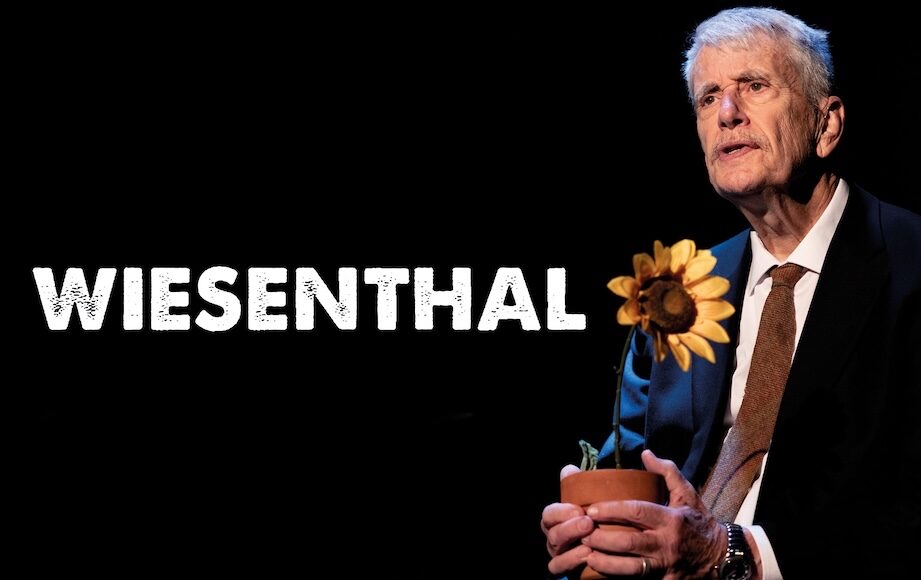

This thought-provoking one-man play, written by Tom Duggan, focuses on Simon Wiesenthal and – following his experiences during the holocaust, and survival of it – his mission post-World War Two to pursue Nazis, ensuring, against the odds, that they faced justice. Christopher C Gibbs convincingly presents a rounded portrait of Wiesenthal, his multi-faceted personality: his humour, determination, the lover, his grief, family man, the philosopher, Jewish and Austrian – a complex human being who endured persecution as a victim of the Nazis.
The signature beret and a coat with a post-it stuck on it, hang on a coat-stand throughout the piece – the post-it reminiscent of the yellow star Jewish people were forced to wear. This clever use of mis-en-scene ensures the importance of the holocaust in Simon Wiesenthal’s life is foregrounded throughout the play. The play takes place in Simon Wiesenthal’s office at the point of his retirement. A potted sunflower represents remembrance and hope referring to Wiesenthal’s book of the same name. In the final action, the sunflower is left on stage, a metaphorical gauntlet thrown down for us to grasp and bear into the future.
Wiesenthal’s core belief was that those who commit crimes against humanity such as the SS are no different from those they victimise; they are not devils; they blindly follow instructions and beliefs, allowing the cruelty lurking below the surface in all of us, to emerge, promoting it. He believed in our collective need to understand all genocides to stop them from recurring throughout time. Dugan interweaves these wider concepts with heartrending intimate personal accounts given by witnesses at the trials of Nazis which Wiesenthal helped to facilitate, articulated by him, bringing an immediacy and humanity to the play.
However, the key question of this piece concerns the issue and duty of remembrance: how to remember – forgiveness versus the quest for justice, who will remember when those with lived experiences are no longer present, where remembrance needs to take place and, most importantly, the trust placed in us as privileged, living survivors by the victims of the holocaust and other genocides to protect and guard their precious memories, ensuring their continuation.
Sotira Kyriakides