

Justice Minister Ionas Nicolaou yesterday declared that the government was acting with “action and not words” after a new draft bill combating hooliganism in sport was submitted to parliament.
The new bill, which Nicolaou said was based loosely on a British model used successfully to stamp out acts of violence at football games in England, had been put through the works at Cabinet level before being placed into the hands of the House Legal Affairs Committee yesterday. He further urged MPs to submit the bill to parliament for approval without too much interference, describing it as “a package” and not “an à la carte menu”.
Some of the elements of the new bill includes stadium bans of up to ten years for troublemakers, harsher prison sentences, compulsory identification cards, stringent seating regulations and better stewarding.
“The government has acted with action and not words through this bill,” Nicolaou told reporters yesterday. “The cabinet has approved arguably the most up-to-date legislation to stamp out acts of violence both in and out of sports arenas. Taking into account Cypriot reality, we have created a combined spectrum of measures based on the British model. It is a complete legislation that commits both the state and the relevant sports authorities.”
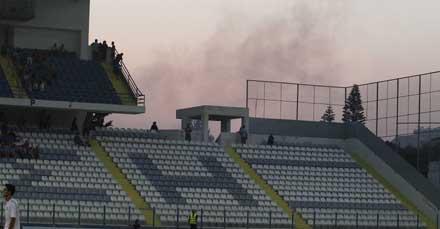
Every year, police and sports club officials appear powerless to stop rampaging hooligans at sports games and last season’s football campaign only highlighted the problems once again. Like many other Mediterranean and Eastern European nations such as Italy, Greece, Turkey, Bulgaria and Serbia, football hooliganism has blighted the beautiful game to the extent where many fans prefer to stay away from sports grounds while millions of euros are paid out in damage costs and extra policing every year without ever any headway being made to stop the rot.
“The future of the bill rests in the hands of parliament where it was submitted today [yesterday]. We are ready to dedicate whatever is needed to parliament. We want to explain and convince the political parties that in order to get results the bill must be approved as a package and not as an à la carte menu. Efforts must be made to ensure that the legislation is passed in its entirety.”
One of the measures which is certain to prompt a response is the banning of mass fan movement to attend football matches – something that will far from impress club supporters groups that always travel in large flocks. But Nicolaou argued that stamping out hooliganism needs to take a front seat.
“We are expecting a response from some of those involved in sport. We are aware of their opinions and we are ready to listen to suggestions that aim to improve the legislative bill but we will not accept trimming down the bill simply because it may put certain people out.”
He added: “Today we begin a new path to change the unacceptable situation for sport in our homeland. Taking this kind of action will not be easy or quick. But it is a path that we must begin and complete. It is a path that needs a joint effort from all – the CSO [Cyprus Sports Organisation], the CFA [Cyprus Football Association], the clubs, the police and the supporters groups.”
Every year, police and sports club officials appear powerless to stop rampaging hooligans at sports games and last season’s football campaign only highlighted the problems once again. Like many other Mediterranean and Eastern European nations such as Italy, Greece, Turkey, Bulgaria and Serbia, football hooliganism has blighted the beautiful game to the extent where many fans prefer to stay away from sports grounds while millions of euros are paid out in damage costs and extra policing every year without ever any headway being made to stop the rot.
Nicolaou says the time has come once and for all to put an end to the carnage.
“The only viable option is joint-cooperation and decisive action from all the relevant bodies without reservations or delays. This effort will be a combined one and everybody needs to have a hand.”
Cyprus Weekly