
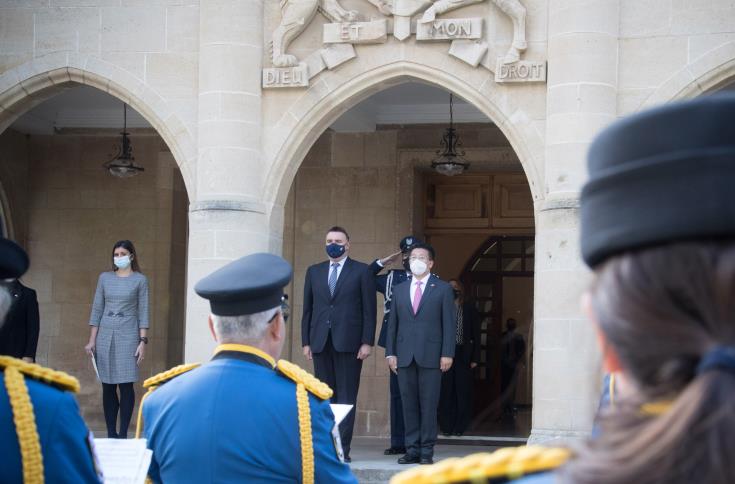

China is exploring mutual recognition of “vaccine passports” with other countries, including Cyprus, says Liu Yantao, the Ambassador of China to Cyprus.
In an interview with CNA, the Ambassador also notes that cooperation between the two sides, also through and knowledge sharing, to increase preparedness for COVID-19.
When it comes to developing safe vaccines, Ambassador Liu underlines that cooperation is key to achieving that goal. Chinese vaccine manufacturers are open to discussion with all potential users, including the EU, he adds.
With 2021 marking the 50th anniversary of the establishment of China-Cyprus diplomatic ties, the Ambassador says preparations for celebrating the occasion are well underway. “We hope that they will give fresh impetus to our friendly and mutually beneficial ties” he notes.
China and Cyprus have worked closely since the initial outbreak of the pandemic last year in terms of donation and procurement of medical supplies, Ambassador Liu stresses, while noting that Cypriot health officials and experts also took part in virtual seminars on COVID-19 prevention and control, initiated by China.
More recently, he says, the Embassy made a donation to an antibody research by Cyprus University, Nicosia University and European University.
For the Ambassador, one of the biggest challenges of COVID-19 we need to overcome is to reduce the impact it has caused to substantially limit our mobility. The acute economic and social consequences are felt worldwide and particularly in countries that depend heavily on tourism, he adds.
“A vaccine passport is by far the best way to gradually restore global travels and business activities that are essential for post-pandemic recovery. China is exploring mutual recognition of vaccine passports with other countries including Cyprus. Joint efforts need to be made by both sides to make the passport technically viable within the parameters of their respective laws and regulations” the Ambassador says.
He notes that China has administered 211 million COVID-19 vaccine doses as of April 21, 2021 and more than 80 percent of the country`s health workers have been vaccinated. “Our goal is to vaccinate as many people as possible to realize herd immunity as soon as possible and keep good control of the pandemic” he adds.
Ambassador Liu also notes that his country has donated or is donating COVID vaccines to nearly 70 developing countries in urgent need, and is exporting vaccines to over 40 countries. Phase III clinical trials of China’s Sinopharm vaccines have been conducted in over 125 countries, while people from 190 countries have been vaccinated with Chinese vaccines either through the market or emergency use, he adds. “We have reports on the good results of Chinese vaccines’ efficacy among diverse target groups and against variants” he adds.
“As we speak, WHO’s review of China`s Sinopharm and Sinovac vaccines for emergency use licensing is proceeding as scheduled. If approved, these two vaccines can be included in the WHO’s Covax program. Chinese manufacturers are open to discussion with all potential users, including the EU” the Ambassador stresses.
He notes that our task is about getting safe vaccines as soon as possible and for as many people as possible, regardless of who developed them. “Cooperation is key to achieving that goal. Facing the common global challenge of the pandemic, what we should really be concerned about is vaccine nationalism, disinformation and politicalization of vaccines” he adds.
Referring to China-Cyprus relations, Ambassador Liu says the friendship is based on mutual trust and shared values. Our bilateral ties have constantly grown throughout the years as we deepen mutually beneficial cooperation and launch joint projects in fields of trade, investment, energy, communications, transport, agriculture, education, culture, he says and expects “China-Cyprus ties to grow further and closer in all dimensions in the years to come.”
He refers, moreover to the MOU signed in 2019, during President Anastasiades’ visit to China, to enhance cooperation within the framework of the Belt and Road Initiative. “Some of the priority areas we are looking at are the jointly building of the Green, Health and Digital Silk Road, which are very relevant in view of the pressing challenges at the moment” he adds.
The Ambassador of China also says he applauds Cyprus’ commitment to a sound and stable China-EU relationship and recognizes Cyprus’ constructive role in fostering closer partnerships and dialogues between China and EU. “Good China-EU relations serve the interests of both sides as well as Cyprus as a member state of EU” he points out.
At present, he says, China-EU relations face both opportunities and challenges. He notes, furthermore, that “it is essential for both sides to look at China-EU relations from a strategic perspective, respect each other’s core interests, to make China-EU relations stay on the right track regardless of disruptions.”
“In view of recent strains between China and the EU, China’s position remains that China and EU are partners not systemic rivals. Efforts need to be made to expand common ground, not create differences which will only cause further misunderstandings” the Ambassador adds.
He says, moreover, that it would be a huge strategic misjudgment to “allow China-EU relations fall victim to the bloc politics and interventionist policies pursued by a third party” and hopes that “the EU will make correct decisions independently and maintain true strategic autonomy.”
Furthermore, Ambassador Liu says that the China-US relationship is currently at an important juncture. It is the common aspiration of both Chinese and American people as well as the international community to see the sound and stable development of China-US relations, he says. As President Xi Jinping stressed to President Joe Biden in their phone call in February 2021, cooperation is the only right choice for both sides, the Ambassador notes.
The Ambassador also speaks about the 14th Five Year Plan and poverty reduction efforts in his country. The latest 14th Five Year Plan clearly defines that China will uphold the new development concepts of innovation, coordinated, green, open and shared development, pay more attention to high quality and sustainable development, and promote a dual-cycle growth pattern relying on both domestic and international economic cycles and with the domestic cycle being the mainstay, he says.
This, according to the Ambassador, marks a major change in the way China engages in the world economy, and says he is convinced that Cypriot companies stand to benefit from this major change of China’s development pattern through China-EU Investment Agreement and China-Cyprus bilateral arrangements.
The Ambassador also notes that one of China’s landmark achievements last year was lifting 98.99 million rural residents living below the current poverty line out of poverty and meeting the poverty eradication target set out in the 2030 Agenda for Sustainable Development 10 years ahead of schedule.
Asked about Hong Kong developments and concerns voiced on the part of the EU, the Ambassador says that “if the EU is really concerned about Hong Kong, it should support China’s efforts. This is the best way to safeguard EU’s interests in Hong Kong.”
He notes that the 2019 unrest “was seemingly sparked by the extradition bill, but many people have ignored the hidden reasons behind.”
Over the past 24 years of practices of “one country, two systems”, while the “two systems” part of the policy has been in force, the “one country” part has not been adequately acknowledged and practiced, he adds.
He brings up various examples, saying that some textbooks in Hong Kong’s primary schools “still contain content that derides China”, or that “certain Hong Kong lawmakers insult their own country while taking the oath of office.” He says moreover that some public office-holders “chose to betray their duty” while “some radicals have even been agitating for the separation of Hong Kong from China.”
Ambassador Liu also says that the unrest was “instigated and orchestrated by external forces, with some Western countries playing a dishonorable role.”
He says finally that the reform was introduced with the aim of “closing the loopholes in Hong Kong’s electoral system and preventing anti-China disruptors from endangering Hong Kong’s stability and security.”
The Ambassador also addresses Western criticism concerning the Uygur population in Xinjiang, saying that it “is basically made up with lies and rumors, nothing but the smearing and slandering of China`s Xinjiang by international anti-China forces and separatist forces.” He says finally that China welcomes people from foreign countries, including Cyprus, to visit Xinjiang and says that anyone not wearing “colored glasses” can easily tell the truth from the lies.