

The colonization of Mars, the Moon and other bodies in our solar system is certain to happen, Andreas Efstathiou, Professor of Science and Mathematics, Vice Rector of Research and External Affairs at the European University of Cyprus, has told CNA.
 Andreas Efstathiou from Paphos spent 18 years in the UK mainly living in the Southgate area and was educated at Queen Mary, University of London. He held appointments at Queen Mary & Westfield College (1989-1992), University of Hertfordshire (1992-1995) and Imperial College London (1995-2001) before joining Cyprus College which evolved into European University Cyprus (EUC).
The Professor, who gave an interview to the Cyprus News Agency, was asked about space, the colonization of other planets, the possible existence of other intelligent beings in the universe, God’s place in this vast space, as well as about a report he has recently co-published in the journal ‘Science’.
Asked about the colonization of other planets/celestial bodies in our solar system by humans, Efstathiou told CNA that “I think the colonization of Mars, the Moon and other celestial bodies in our solar system is certain to happen and I strongly support it”.
Noting that the desire for exploration and discovery is one of the most basic and exciting aspects of the human character and it is a driving force for the development of our civilization, he said that the colonization of the rest of the solar system is certainly a significant challenge and it will take time, probably more than a century to happen.
“But it will lead to the development of a new technology as in the case of the Apollo missions to the Moon. It will also inspire entire generations of young people to pursue careers in science and technology,” he said.
Since, according to some estimates, in the observable universe there are approximately 500 billion galaxies, CNA asked the Professor about the chances of other intelligent beings existing somewhere in the universe.
Efstathiou said that in the past 25 years it has been established that the presence of planets around other stars is very common and it is true that there is an extremely large number of galaxies each of which has an extremely large number of stars.
“We still don’t know however, how rare it is to have a planet like the earth, which is at the habitable zone of its star, it has water and suitable atmosphere and the necessary stable conditions over billions of years in order for life to start and evolve”.
He explained that one does not know how long it can take for life to start once the right conditions are there and how inevitable it is for intelligent life to evolve, nor do we know what the life expectancy of an advanced civilization is and what the chance of destroying itself can be.
Pointing out that “unless we know these factors, we cannot really determine how many civilizations like our own there are in this particular time in the history of the universe”, he said that “My personal feeling is that there are other intelligent beings somewhere in this vast universe but they may be so far away that it may not be practical to identify them or communicate with them.”
Asked about the currently accepted model for the universe, he said that it is known as the Lambda Cold Dark Matter model or ΛCDM.
“According to this model the universe began with the Big Bang which occurred 13.8 billion years ago and it has been expanding ever since. Most of the mass/energy of the universe is not in the form of the ordinary matter of which the planets, the stars and ourselves are made of but in the form of dark matter and dark energy,” he told CNA.
The dark energy, he added, which in this model makes up about 70% of the energy of the universe, is thought to be responsible for the accelerated expansion of the universe.
“The nature of dark matter and dark energy is not known yet and trying to find it is one of the main open questions in Cosmology. I believe that this model has a lot of attractive features and explains a lot of observations in Cosmology. I feel fortunate that I participate in numerous projects that aim to test this model and refine it,” he told CNA.
Efstathiou was also asked about the theory of the holographic universe.
“The idea of the holographic universe is based on the idea of the holographic principle which is a property of quantum gravity. It has been claimed, on general physical principles, that evidence for the holographic principle may be found in the form of background noise in gravitational wave detectors which are in the planning phase”.
However, he went on to say, “these claims have not been widely accepted, or cited, among quantum gravity researchers and appear to be in direct conflict with other theoretical calculations”.
“I therefore believe that this is an attractive idea but without any firm experimental basis at the moment”, he said.
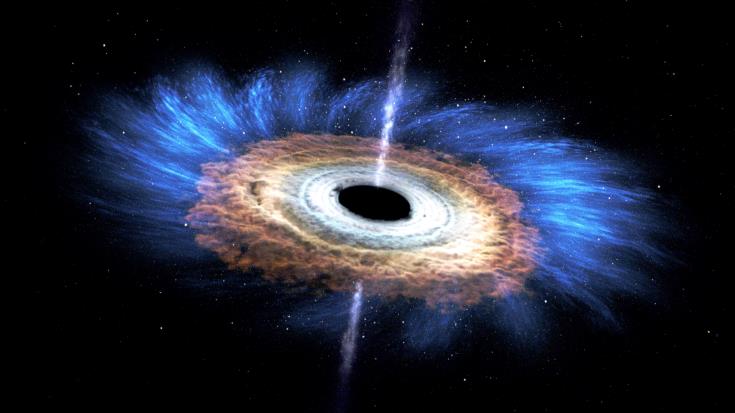
CNA talked to the Professor about a report he co-published in the journal ‘Science’ on “A dust-enshrouded tidal disruption event with a resolved radio jet in a galaxy merger.”
“The phenomenon we discovered in the pair of galaxies Arp 299, known as a tidal disruption event (TDE), has been predicted theoretically about thirty years ago to be very common but so far very few such events have been detected. The importance of our discovery is that it is the first time we observed the jet of material ejected by the black hole following the destruction of a star,” he said.
Efstathiou added that it is also important that this event radiated most of its energy as infrared and radio radiation whereas previous events radiated optical radiation and X-rays.
This implies, he explained, that the event may be very common as predicted but one just needs to observe at infrared wavelengths to find them.
“Observations like this may become common with future telescopes like NASA’s James Webb Space Telescope due for launch in 2021,” he continued.
So, is there room for God in this vast universe?, CNA has asked.
The Professor said that the universe in which we live is not only vast but also very complicated.
“Despite the tremendous progress made by science over thousands of years, there are a number of phenomena which we cannot yet explain and understand satisfactorily and there may still be other phenomena and physical laws we have not discovered yet,” he said.
Science, he added, is based on drawing conclusions from data and evidence and many scientists believe that there is no evidence for God.
Pointing out that “according to the well-known expression though, absence of evidence is not evidence of absence”, he said “My personal opinion therefore is that there is a place for God in this vast universe but we may not be in a position yet to understand this place fully because the Being that created this universe is certainly much wiser than us”.