
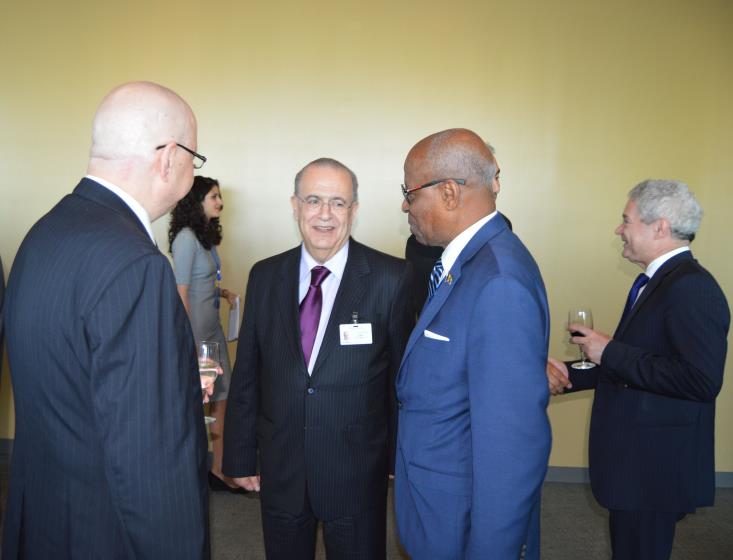

Kasoulides participated on Friday in a high-level open discussion of the Security Council on the protection of civilians in the context of peacekeeping operations. The meeting was convened by the French Presidency of the Council.
In his speech, Minister Kasoulides said that Cyprus subscribes to the statement delivered by the European Union adding that the need for the protection of civilians during armed conflict could not be more self-evident.
“Yet, and despite progress in the efforts to protecting civilians in the past years, the situation for civilians in today’s conflicts remains deeply worrisome, as identified in the latest UN SG report, and stems from the disrespect of international humanitarian law and lack of accountability”, he noted.
Protection of civilians, he continued, “remains an obligation of all UN peace operations and forms part of the mandate of currently 10 peacekeeping missions. However, the role of UN peacekeeping in this regard should not undermine the primary responsibility of governments to provide protection to their citizens”.
“My country is the host of a peacekeeping force in its territory, UNFICYP, since 1964, whose mandate also includes providing humanitarian assistance. Cyprus is grateful to the UN and the troop contributing countries for their assistance. Our experience has informed our understanding of the difficulties in implementing a peacekeeping mandate”, he stressed.
Moreover, he said that “we believe that collective experience on peacekeeping operations has revealed persisting challenges in implementing protection of civilians. It has also shown that expectations are often unrealistic”.
“Significant steps for improving the situation should include informed threat assessments and planning to be complimented with the necessary capabilities, including rapid deployment capabilities. Objective, frank and timely reporting to the Security Council is of crucial importance, while the use of indicators should assist in measuring progress”.
He noted that “effectiveness will also largely depend on the mandates, which should provide for exit strategies, always guided by the situation on the ground, and be linked to political solutions. Mandates should be clear, coherent and concise, with realistic provisions, human rights provisions where it is relevant and accompanied by clear operational guidelines”.
Furthermore, he said, “the need for pre-deployment and in-mission training on issues of protection of civilians, sexual violence in conflict and child protection, as well as on understanding the political and historic perspective of the host country cannot be overemphasized”.
“Peacekeeping operations personnel should uphold high human rights standards. In this framework, we fully support the UN SG’s policy on zero tolerance of sexual exploitation and abuse in peacekeeping operations. Good, trustworthy relations with local communities and organizations can prove beneficial in preventing crimes against civilians, identifying warning signals for atrocity crimes and dealing with the consequences of any violations against civilians”.
The Minister said that “Peacekeeping missions can also have a role in assisting a host state to implement its Responsibility to Protect and in assisting the ICC’s work, when the latter is involved in a country where a peacekeeping mission is deployed”.
Complementary to the work of peacekeeping missions, he added, “UN member states, and regional and international organizations also have a role to play in conflict prevention and early warning response. In this framework, Cyprus has committed, during the World Humanitarian Summit, on using diplomacy for conflict prevention and on supporting the Human Rights up Front Initiative of the UN.
“We look forward to seeing a strengthened effectiveness of peacekeeping missions in implementing their mandates on protection of civilians. Cyprus expresses its full support to this effort”, he concluded.