
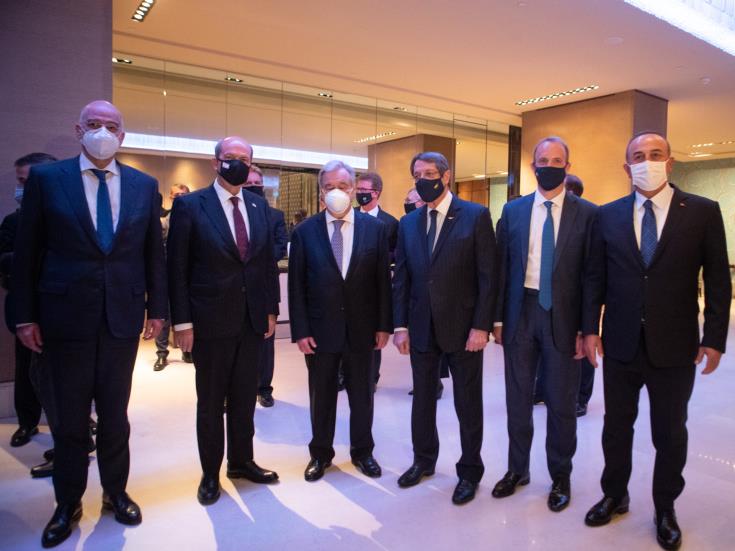

Efforts are underway in Geneva for a joint statement to be issued at the end of the 5+1 informal meeting on Cyprus which the UNSG has convened. For this reason, the UN have undertaken the task to prepare a document which will be accepted by the parties.
However, if this is not possible, a statement by UNSG Antonio Guterres will be pursued in which the President of the Republic Nicos Anastasiades asked to include a reference to UN resolutions and the basis for a solution which the resolutions provide.
According to the available information, the first separate bilateral meetings which Guterres held on Tuesday with President Nicos Anastasiades and Turkish Cypriot leader Ersin Tatar confirmed the gap in both sides’ positions while the Greek Cypriot side insisted that it will not accept any change of the solution, as defined by UN Security Council resolutions and it is not willing to accept a two-state solution that will recognise sovereignty of any form.
During his meeting with Guterres, Tatar insisted on a two-state solution while the Greek Cypriot side underlined that the “UNSG must undertake some initiatives so that a deadlock will not result”, offering his mission of good offices creatively, in the framework of his mandate.
Guterres informed President Anastasiades on the positions presented by Tatar on a two-state solution, sovereign equality and recognition of the illegal regime in the Turkish occupied north of the island.
On his part, President Anastasiades asked the SG, within the framework of his mandate, to undertake a creative intervention like he did in Crans Montana to find a way out.
Meanwhile, during the informal conference in Geneva, the Greek Cypriot side will submit in writing its positions and answers to the positions outlined by the Turkish Cypriot side.
This, as a competent source explained, will be done provided there will be no arguments in response to the positions of the other side as they are submitted during the plenary meeting of the informal conference. A source from the Greek Cypriot side denied reports that the Turkish Cypriot side had submitted proposals.
The same source said that President Anastasiades underlined to the SG the need for a solution of the Cyprus problem within the parameters of UN decisions and resolutions and specifically referred to resolutions 1251 and 2561.
He also referred to the convergences achieved as they are outlined in the UNSG’s document submitted at Crans Montana and the parameters that need to be taken into consideration since Cyprus is an EU member state.
President Anastasiades also raised the issue of confidence building measures, as well as his proposal for the fenced off area of Famagusta.
He also noted specific events of concern, such as the recent ruling by the “supreme court” in the occupied areas on the teaching of the Koran and Turkish President Recep Tayyip Erdogan’s intervention, noting that Ankara considers Turkish Cypriots as its subjects.
President Anastasiades informed the members of the National Council on Tuesday evening on his meeting with Antonio Guterres.
During the reception hosted by the UNSG for the parties of the informal conference, there was no opportunity for a substantial discussion between attendees due to the seating which is the result of COVID-19 measures.
At 1900 on Wednesday, President Anastasiades will meet with British Foreign Secretary Dominic Raab. It was clarified that the conference will conclude on Thursday.
Farhan Haq, Deputy Spokesman for the Secretary-General announced during Tuesday`s briefing at the UN headquarters in New York that more meetings are expected on Thursday, for which the UN will release details later.
“The purpose of the meeting will be to determine whether common ground exists for the parties to negotiate a lasting solution to the Cyprus issue within a foreseeable horizon”, he added.
Cyprus has been divided since 1974, when Turkey invaded and occupied its northern third. Repeated rounds of UN-led peace talks have so far failed to yield results.