
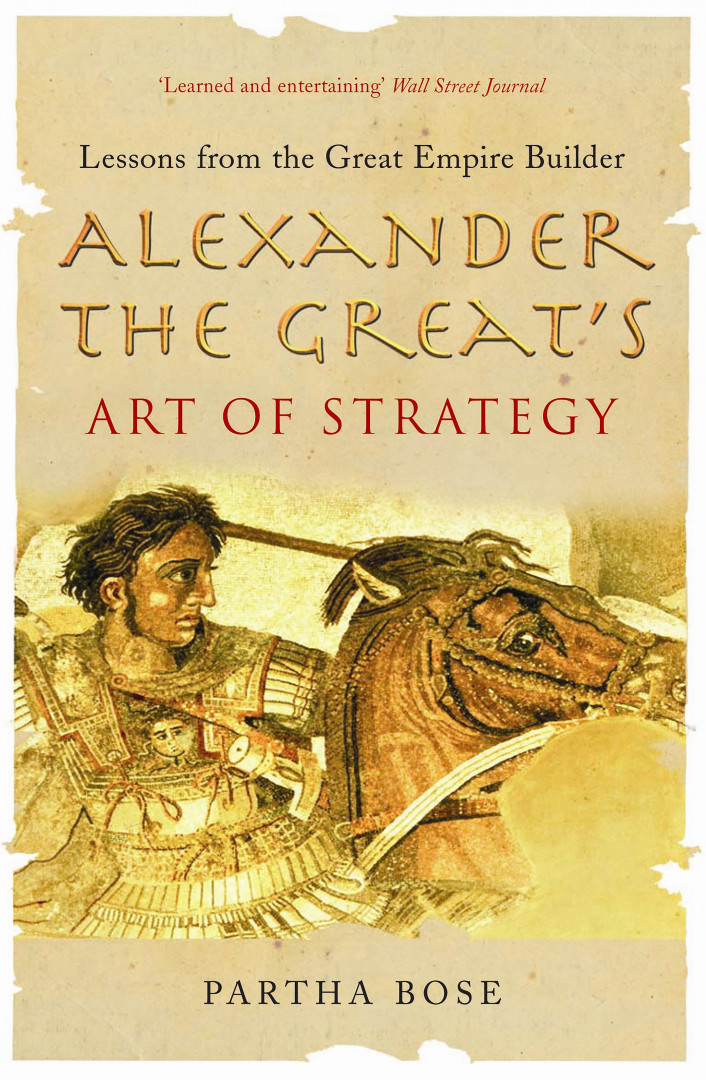

Alexander the Great’s Art of Strategy
The short, spectacular life of Alexander the Great has always been Hollywood material. By the time of his death aged just 32 in 323 BC, the Macedonia – born Alexander had conquered the ancient world, extending his empire across one million square miles from Greece to India.
In his last big screen incarnation, Alexander, played by Colin Farrell in the eponymous Oliver Stone – directed epic, is portrayed as the greatest warrior in history. But many business experts believe the lessons of Alexander’s career have as much relevance for boardroom as battlefield strategists.
According to Partha Bose, author of “Alexander the Great’s Art of Strategy”, modern executives can learn from Alexander’s campaigns in three key areas: “it is where you want to compete, when and how you want to enter or exit that market and how do you want to go about competing when you are in that market,” says Bose.
“Strategy is only as good as the organization’s ability to execute it. Here again, there are lessons from ancient times.”
One modern manager who has drawn inspiration from Alexander’s campaigns is Federal Express founder and CEO Fred Smith: “Primary was his organizational skills. He organised his army in a way that had never been done. That organisation allowed him to play to his strengths, minimize his weaknesses and prevail over opponents who were much larger.”
In Stone’s cinematic portrait, Alexander’s greatest achievement comes at the Battle of Gaugamela where his 50,000-strong Macedonian army defeats the forces of the Persian King Darius, five times its size.
Stone believes Alexander’s tactical flexibility and willingness to delegate authority gave him a decisive military advantage: “He had great instincts in battle. He was very fluid, always changing as the battle developed. He was quick to react. Alexander was a great believer in teamwork and he delegated authority beautifully.
“The Persians could not move without central approval. It was all governed by Darius in the centre. Alexander went for the head. He knew that if he killed Darius he would kill the snake.”
Bose agrees that delegation and instinct were central to Alexander’s thinking: “We see him trusting a nine-year-old shepherd boy, and getting this shepherd boy to lead the entire army over the Uxion Mountains in Persia,” he says.
“There are many other situations where he would put his trust just like that in whoever it was he encountered. But a sign of great leadership is that great leaders know whom to trust and do put their faith in lots and lots of people. But for all Alexander’s improvisational abilities on the battlefield, his achievements were also a consequence of careful preparation and forward thinking.
“We know that there was significant rehearsal and planning,” says Stone. “They even had markers, they drew marbles of the enemy, they drew carved statues and they made battle plans like they do at West Point today.”
In war, Alexander could be a brutal and cunning opponent. Yet his empire was founded on a respect for local cultures and a belief that peace and internal stability could only exist through prosperity.
“All throughout his life you see Alexander going out of his way to embrace other cultures, and the cultures that he did invade saw that he wasn’t trying to impose on them his way of doing things,” says Bose.
“What was happening was that the local culture and the Greek culture would melt together in ways that even the people who were conquered found quite interesting and innovative.
“The Nestles, the Unilevers or the Procter and Gambles of the world have been able to succeed across the globe because none of them imposed a system on the nations they were going into that came from their origins.
“They all worked out something that was in line with the local cultures and local tastes, and that is what globalization is all about. So there are really a lot of great leaders and part of their greatness lies in being able to adapt themselves to the local cultures.”
Smith, who describes Alexander as “the first truly global thinker,” says Federal Express has tried to emulate that approach when moving into new markets.
“We have to deal with different cultures, attitudes, and different people. Doing that is part of our company’s success,” he says.
“I think Alexander was the first person who did that successfully. He didn’t just capture and enslave them. He was enormously successful in putting together a truly global empire.”
CNN’s Robyn Curnow
edition.cnn.com
Greek Hero as Consultant
With Partha Bose’s new study of Alexander the Great, subtitled ‘Lessons from the Great Empire Builder’, he has written a book for the age of American empire: a manual for the military, political and commercial elite of an America coming to terms with its imperial destiny.
Bose is not alone in his enthusiasm for Alexander. For the life of Alexander the Great contains all the elements of a blockbuster.
Born in 356 BC the son of King Phillip II, Aristotle tutored him and although the Greek philosopher passed on much wisdom, he didn’t instill in Alexander the virtues of the contemplative life. After his father’s assassination, he assumed power and rapidly grew his empire from Macedonia to encompass Greece, Persia, Afghanistan and northern India. He won a string of military victories, performed acts of great personal bravery and showed himself a master of wartime tactics – most spectacularly at the battle of Issus, where he led the Greeks to victory against their Persian foe despite being outnumbered eight to one. And he kept up his truly heroic capacity for sustained alcohol abuse.
The global reach of Alexander’s ambitions, his ability to march his army to the edge of the known world, appeals to Bose. He adeptly guides us through Alexander’s imperial ventures in Afghanistan and modern Iraq.
The book’s thesis is that much modern management technique can be drawn from Alexander’s mastery of strategy and leadership. Bose credits Alexander as the first general to focus on tactical positioning rather than brute force; on prioritising the terrain of conflict; on selecting careful exit strategies; and being able successfully to adapt his leadership style to suit the moment.
Alexander’s achievements were the product of an incredible leadership force that inspired even old men to return to military service under him.
His character drove his conquests. Unfortunately, Bose gives us too little sense of Alexander the man and too much of arcane management theory. He would do his audience a service by revealing that it was Alexander’s personality and delusional megalomania that in the end killed his dream of empire.
Lessons from the Great Empire Builder
Leadership according to Alexander the Great: If you think you rule the world, maybe you do.
Partha Bose agrees that “Alexander the Great’s Art of Strategy” book cannot be a part of strictly one genre. It is an intriguing book that involves numerous of categories as leadership, management, self-development, war, history, and philosophy.
It is a military orientated, extraordinary and exciting book, which demonstrates the ability of a great leader to avoid rebellions from the conquered people against the state with love and kindness. Alexander once said: “I am not afraid of an army of lions led by a sheep.” This quote shows the importance of real leadership.
“Alexander the Great’s Art of Strategy Summary”
One of Greece’s greatest poets Archilochus once said, “the fox is open for new knowledge, but the hedgehog sticks to the thing it knows best.” 356 years before Christ on July 26, one extraordinary boy was born in the capital of ancient Macedonia known by the name – Pella.
The legacy started with a whisper – Alexander the Great. He began and ended his education with none other than Aristotle, a philosopher who taught him (over the years) how to combine fox’s broader knowledge with hedgehog’s wisdom.
Who supported Alexander?
Aristotle advocated for universality while discovering the human’s essence. History remembers him not only as the teacher to the greatest conqueror that ever-existed “Alexander the Great” but also as a theorist and philosopher.
The military impact of Alexander the Macedon has its difficulties to be expressed without any exaggeration; the same goes for his excellent tutor.
Alexander’s sharp mind and strategic thinking are the embodiment of the influence he had over different conquerors and rulers through the ages. Many of them, were amazed by Alexander’s unique approach in a battle.
Today’s children, as well as grown-ups, are introduced to Aristotle’s wisdom, which shows us a great depth even though his work dates 24 centuries ago. Army generals of the modern world are still using some of his techniques to fight terrorism. Indeed, a real leader must be open – knowingly or unknowingly – for new knowledge, the same thing that was mastered by Alexander.
Key Lessons from “Alexander the Great’s Art of Strategy”
Globalization was practiced centuries ago – You think of Globalization as something new. Well, don’t be surprised to know that Alexander was practicing and understood the term globalization almost two thousand years ago.
Every endeavour must start with mapping a strategy. Alexander’s approach was systematic, with a clear ultimate goal on his mind, and the rest will follow.
Be prepared for anything; make a plan for everything – What happens when a king has no successor? At age 32 Alexander was experiencing the first signs of weakness, probably because of malaria. His army was demoralized because of his illness and didn’t want to proceed in battle.
Alexander had no son, so the people asked him: Who would succeed him when he dies? He barely replied, “I hope – the strongest one of all.”
The genuine approach – Aristotle had one fascinating philosophy that he shared with Alexander. Being a true leader means to be angry at the right person, at the right place, at the right time and most importantly for a good reason.
Alexander memorized these words of wisdom and carried them in his heart.
Alexander the Great (356 – 323 BC)
Alexander III of Macedon, better known as Alexander the Great, single-handedly changed the nature of the ancient world in little more than a decade.
Alexander was born in Pella, the ancient capital of Macedonia in July 356 BC. His parents were Philip II of Macedon and his wife Olympias. The philosopher Aristotle educated Alexander. Philip was assassinated in 336 BC and Alexander inherited a powerful yet volatile kingdom. He quickly dealt with his enemies at home and reasserted Macedonian power within Greece. He then set out to conquer the massive Persian Empire.
Against overwhelming odds, he led his army to victories across the Persian territories of Asia Minor, Syria and Egypt without suffering a single defeat. His greatest victory was at the Battle of Gaugamela, in what is now northern Iraq, in 331 BC. The young king of Macedonia, leader of the Greeks, overlord of Asia Minor and pharaoh of Egypt became ‘great king’ of Persia at the age of 25.
Over the next eight years, in his capacity as king, commander, politician, scholar and explorer, Alexander led his army a further 11,000 miles, founding over 70 cities and creating an empire that stretched across three continents and covered around two million square miles. The entire area from Greece in the west, north to the Danube, south into Egypt and as far to the east as the Indian Punjab, was linked together in a vast international network of trade and commerce. This was united by a common Greek language and culture, while the king himself adopted foreign customs in order to rule his millions of ethnically diverse subjects.
Alexander was acknowledged as a military genius that always led by example, although his belief in his own indestructibility meant he was often reckless with his own life and those of his soldiers. The fact that his army only refused to follow him once in 13 years of a reign during which there was constant fighting, indicates the loyalty he inspired.
He died of a fever in Babylon in June 323 BC.
Book by Partha Bose. Source: Tristram Hunt, www.managementtoday.co.uk, blog.12min.com and en.wikipedia.org