
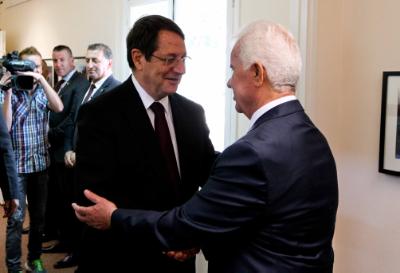

In Europe, they realize that they should be more actively involved in the process for the reunification of Cyprus, Cyprus President Nicos Anastasiades said on Tuesday.
He was speaking during a public consultation, at the Presidential Palace.
Cyprus has been divided since 1974 when Turkey invaded and occupied its northern third. UN led talks have been underway since February aiming to reunite the island under a federal roof.
President Anastasiades said that in Europe they realise that they should be more actively involved (in the process) whilst at the same time the government’s effort is to mobilise countries which can influence Turkey with the goal of creating a new dynamic towards a review of Turkey`s stance.
He said that the existence of hydrocarbon reserves within Cyprus` Exclusive Economic Zone is of “strategic importance”.
Referring to efforts for the return of the fenced off part of the city of Famagusta, known as Varosha, in the framework of confidence building measures, President Anastasiades noted that the government is faced with a rigid stance on the part of Turkey.
Abandoned by its Greek Cypriot inhabitants as they fled the advancing Turkish troops in the summer of 1974, Varosha stands deserted under Turkey`s direct control since then. The UN has called for the return of the town to its lawful inhabitants but so far Ankara refuses to comply with such calls.
Replying to a question on the matter, he said that we are faced with a rigid Turkish stance even as regards a gradual action on the matter which would include three phases.
The first phase, he explained, would entail experts reviewing the state of the city`s infrastructure as regards habitation, the second phase would start with the city been handed over to the UN and the third to its residents.
President Anastasiades said that despite the intransigent stance he is faced with on the part of Turkey, he has not given up.
At the same time he assured he continues and will continue his efforts in order to avert a worst case scenario which would be, as he said, the division of the island and the insecurity Greek Cypriots would feel if the Cyprus problem remained unresolved.
Replying to another question he said that there will have to a be comprehensive agreement on a solution between the two sides before the people are asked to vote on it by way of referendum.
The effort he said is to create the conditions for a dialogue in the right framework. He recalled that efforts to agree on the joint statement signed between himself and Turkish Cypriot leader Dervis Eroglu took between three to four months, but that the statement contains significant improvements on previous High Level Agreements, which ensures, inter alia, that the state will have a single sovereignty, a single international personality and a single citizenship and that the acquis communautaire and human rights will be in force and implemented throughout the island.
Our efforts are aimed towards achieving a solution which will meet the expectations and worries of the Greek Cypriots, will safeguard Greek Cypriot presence in the island and will create a modern European state, he added.
Referring to the economy President Anastasiades pointed out that Cyprus must abide by the terms of its adjustment programme and honour the obligations undertaken in order for the economy to recover.
In March 2013 the Cypriot government agreed with the EU and the IMF on a €10 billion financial assistance programme featuring an unprecedented haircut on uninsured banking deposits to recapitalise the island`s largest lender, coupled with capital restrictions. As a result the economy contracted by 5.4% of GDP in 2013, which was way less than 8.7% initially projected by Cyprus` lenders.
For 2014 the Troika (EC, ECB and IMF) revised its projections to a 4.2% contraction from an earlier 4.8%. The Cypriot programme is reviewed on a quarterly basis with new projections issued after each review. For 2015 the projections revised downwards for growth of 0.4% of GDP from the initial 0.9%.
Recently the government has said it will decide in the coming weeks on Cyprus` exit to the international markets. The exit will come more than a year earlier than originally anticipated.
President Anastasiades noted that with the trust of international markets in Cyprus restored, investor interest in Cyprus has also been increasing, which will in turn lead to the creation of new jobs and eventually Cyprus will return to unemployment levels of under 3%.
He was also asked of Cyprus` application to become a member of the Partnership for Peace programme (PfP).
As an EU member one should participate in all the policy areas and the PfP is not an alliance for war but for peace, he said. He added that it is a wider group of states which go beyond the narrow EU member state circle and includes many countries including the Russian Federation.
Through such participation there is an exchange of classified information and an active participation in peace missions.
As regards NATO, President Anastasiades said that his position is that if the majority of political parties consent then “we could apply for NATO membership”.