
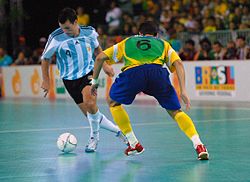

Whilst the country is gearing up to support Roy Hodgson’s men in Brazil, a little bit of the samba spirit hits Newcastle this week, as Futsal takes over the north-east.
The England Futsal team hosts a Four Nations tournament that includes USA, Cyprus and Qatar at the Northumbria University from Thursday 5 June to Sunday 8 June.
Each nation will play each other over the coming days to determine the winner of the tournament, and England will fancy their chances of claiming victory, particularly with the matches taking place on home-soil with the full-support of a passionate north-east crowd.
Match schedule
Thursday 5 June
5:30pm – USA v Qatar
8pm – England v Cyprus
Friday 6 June
5:30pm – Cyprus v USA
8pm – England v Qatar
Sunday 8 June
1pm – Cyprus v Qatar
3:30pm – England v USA
While the England camp has every reason to be optimistic, the American’s will be coming to Newcastle as arguably the favourites to win the tournament.
USA are the highest-ranked team in the competition by quite some distance (No34 in the World), and having beaten England 2-1 in an epic encounter last year will feel confident that they can repeat that achievement on this occasion.
The Three Lions also have recent history with the other two nations, playing Qatar for the first time last autumn in Doha – winning the first game 3-1 before drawing a 6-6 thriller.
And over recent years, England have enjoyed mixed fortunes in a number of dramatic and significant matches against Cyprus.
The two nations have been drawn regularly against each other in UEFA Euros and FIFA World Cup groups and faced each other in three separate qualifying tournaments since 2009: on each occasion England winning narrowly. However, in 2010 England travelled to Cyprus were beaten heavily in two friendly matches.
What is Futsal
Futsal (Portuguese pronunciation: [futsal]) is a variant of association football that is played on a smaller field and mainly played indoors. It can be considered a version of five-a-side football. Its name comes from the Portuguese futebol de salão, which can be translated as “hall football”. It was developed in Brazil and Uruguay in the 1930s and 1940s.
In Brazil futsal is played by more people than football but does not attract as many spectators as the outdoor sport. Several futsal players have moved on to careers as successful professional football players.
Players, equipment and officials
There are five players on each team, one of whom is the goalkeeper. The maximum number of substitutes allowed is nine (FIFA change 2012), with unlimited substitutions during the match. Substitutes can come on even when the ball is in play but the player coming off must leave the pitch before the substitute can enter the playing field. If a team has fewer than three players in the team, the match is abandoned and counted as a loss for the team with the lack of players.
The kit is made up of a jersey or shirt with sleeves, shorts, socks, shinguards made out of rubber or plastic, and shoes with rubber soles. The goalkeeper is allowed to wear long trousers and a different coloured kit, to distinguish himself from the other players in the team and the referee. He is also allowed to wear elbow pads because the surface is about as hard as a tennis court or basketball court. Jewellery is not allowed, nor are other items that could be dangerous to the player wearing the item or to other active participants.
The match is controlled by the referee, who enforces the Laws of the Game, and the first referee is the only one who can legally abandon the match because of interference from outside the pitch. This referee is also assisted by a second referee who typically watches over the goal lines or assists the primary referee with calls on fouls or plays. The decisions made by the referees are final and can only be changed if the referees think it is necessary and play has not restarted.[ There is also a third referee and a timekeeper, who are provided with equipment to keep a record of fouls in the match. In the event of injury to the referee or second referee, the third referee will replace the second referee.
The pitch
A futsal pitchThe pitch is made up of wood or artificial material, or similar surface, although any flat, smooth and non-abrasive material may be used. The length of the pitch is in the range of 38–42 m (42–46 yd), and the width is in the range of 20–25 m (22–27 yd) in international matches. For other matches, it can be 25–42 m (27–46 yd) in length, while the width can be 16–25 m (17–27 yd), as long as the length of the longer boundary lines (touchlines) are greater than the shorter boundaries where the goals are placed (goal lines). The “standard” size court for an international is 40 m × 20 m (44 yd × 22 yd).[12] The ceiling must be at least 4 m (4 yd) high. A rectangular goal is positioned at the middle of each goal line. The inner edges of the vertical goal posts must be 3 m (3.3 yd) apart, and the lower edge of the horizontal crossbar supported by the goal posts must be 2 m (2.2 yd) above the ground. Nets made of hemp, jute or nylon are attached to the back of the goalposts and crossbar. The lower part of the nets is attached to curved tubing or another suitable means of support. The depth of the goal is 80 cm (31 in) at the top and 1 m (3.3 ft) at the bottom.
A futsal arena in TokyoIn front of each goal is an area known as the penalty area. This area is created by drawing quarter-circles with a 6 m (6.6 yd) radius from the goal line, centred on the goalposts. The upper part of each quarter-circle is then joined by a 3.16 m (3.46 yd) line running parallel to the goal line between the goalposts. The line marking the edge of the penalty area is known as the penalty area line. The penalty area marks where the goalkeeper is allowed to touch the ball with his hands. The penalty mark is six metres from the goal line when it reaches the middle of the goalposts. The second penalty mark is 10 metres (11 yd) from the goal line when it reaches the middle of the goalposts. A penalty kick from the penalty spot is awarded if a player commits a foul inside the penalty area.] The second penalty spot is used if a player commits his team’s sixth foul in the opposing team’s half or in his own half in the area bordered by the halfway line and an imaginary line parallel to the halfway line passing through the second penalty mark; the free kick is taken from the second penalty mark.
Any standard team handball pitch can be used for futsal, including goals and floor markings.
Duration and tie-breaking methods
A standard match consists of two equal periods of 20 minutes. The length of either half is extended to allow penalty kicks to be taken or a direct free kick to be taken against a team that has committed more than five fouls. The interval between the two halves cannot exceed 15 minutes.
In some competitions, the game cannot end in a draw, so away goals, extra time and penalties are the three methods for determining the winner after a match has been drawn. Away goals mean that if the team’s score is level after playing one home and one away game, the goals scored in the away match count as double. Extra time consists of two periods of five minutes. If no winner is produced after these methods, five penalties are taken, and the team that has scored the most wins. If it is not decided after five penalties, it continues to go on with one extra penalty to each team at a time until one of them has scored more goals than the other. Unlike extra time, the goals scored in a penalty shoot-out do not count towards the goals scored throughout the match.
The start and restart of play[edit]At the beginning of the match, a coin toss is used to decide who will start the match. A kick-off is used to signal the start of play and is also used at the start of the second half and any periods of extra time. It is also used after a goal has been scored, with the other team starting the play.
After a temporary stoppage for any reason not mentioned in the Laws of the Game, the referee will drop the ball where the play was stopped, provided that, prior to the stoppage, the ball was in play and had not crossed either the touch lines or goal lines.
If the ball goes over the goal line or touchline, hits the ceiling, or the play is stopped by the referee, the ball is out of play. If it hits the ceiling of an indoor arena, play is restarted with a kick-in to the opponents of the team that last touched the ball, under the place where it hit the ceiling.
Lack of offside rule
Unlike football, there is no offside rule in futsal. Attackers can get much closer to the goal than they can in the traditional outdoor version of football.