

Acclaimed actress Irene Papas, whose repertoire ranged from ancient Greek heroines to resistance fighters, was born on September 3, 1926. She died of complications from Alzheimer’s disease on September 14, 2022, aged 96.
Papas claimed that she did not play passionate characters, but “I am those characters . . . That passion is my truth.”
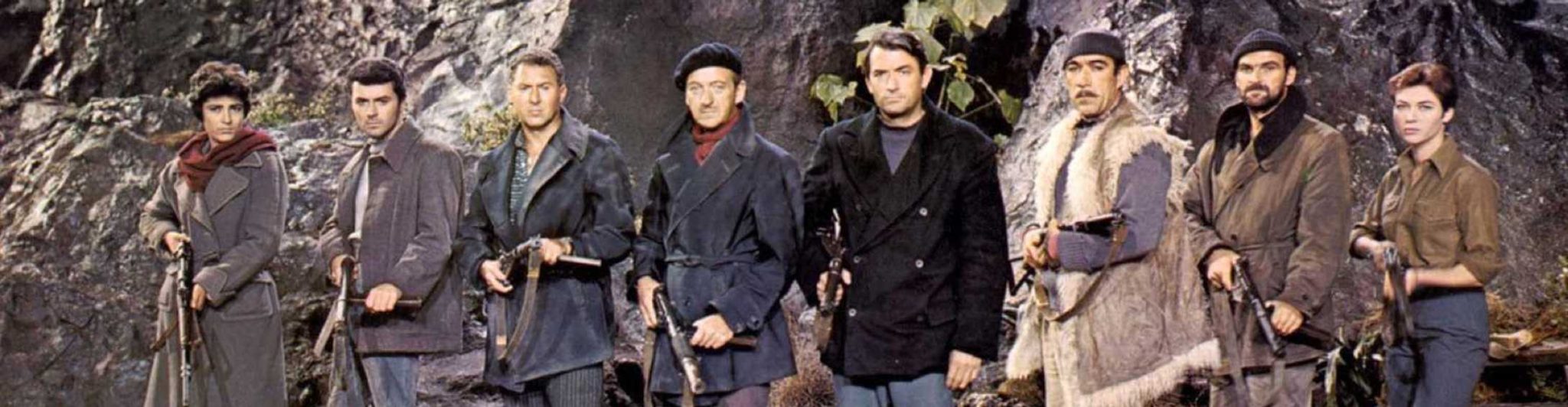
With hypnotic eyes, jet-black hair and a sharp, electrifying intelligence, she was perhaps best remembered as Maria, a resistance fighter who dares to shoot an unarmed female traitor when her colleagues hesitate in the Second World War film The Guns of Navarone (1961) starring Gregory Peck and Anthony Quinn. At one point during the filming, when her character is interrogated and tortured by an SS officer played by George Mikell, she asked for the scene to be reshot, insisting: “The torture must look real. I can take it.”
She also played the young widow who is beaten and stoned by villagers after a night of passion in Zorba the Greek (1964), and triumphed with performances in leading classical roles such as Antigone (1961), Electra (1962) and, as Electra’s mother, Clytemnestra, in Iphigenia (1977).
Elsewhere she was Kirk Douglas’ wife in the 1968 mafia film The Brotherhood and the following year played Catherine of Aragon, the discarded wife of Richard Burton’s Henry VIII, in Anne of the Thousand Days.
“I prefer Anne (Boleyn) to Catherine,” she told one interviewer. “Catherine already had 20 years of Henry. Why not let another woman have a chance? But don’t quote me, because the English adore their suffering Queen Catherine.”
If historical intrigue was not enough, Papas also became embroiled in contemporary intrigue in her homeland. After the generals took over Greece in 1967, she emerged as a powerful critic of the junta, calling for a cultural boycott against “the fourth Reich”. At a press conference in Rome she described the junta as “a ridiculous little bunch of half-educated colonels” and “no more than a bunch of blackmailers.”
Such vehement opposition drove her into exile, living in hotel rooms in Italy and New York. Yet she was equally outspoken about American influence in her homeland. “We are nothing but an American colony,” she declared. “We import chewing gum and automobiles, books and records and culture. No wonder the Americans have done nothing against the junta.”
She was able to return in 1974 after the fall of the regime, but her strident views remained.
In her telling, society’s problems could be traced back to antiquity. “Plato made the first mistake,” she said. “He began to talk about the soul and morality, and he prevented the Epicureans from searching the nature of man. So Plato delayed the scientific and technical revolution for 3,000 years.”
She was born Irene Lelekou in 1926 in Chiliomodi, a village outside Corinth in Greece, one of four sisters. Their mother, Eleni was a schoolteacher, while their father, Stavros, taught classical drama in Corinth. He had “a consuming passion for ancient Greek culture and every day we were served Sophocles and Euripides for breakfast.” Later she returned frequently to her childhood home.
She was seven when the family moved to Athens, where at age 15 she joined the city’s Royal School of Dramatic Art and soon became something of a rebel. She disliked the school’s prescriptive and what she considered to be dated approach to acting, instead developing her own acting style. This led to her being held back a year, but after graduating she immersed herself in the profession, appearing in countless plays.
Her sole encounter with organised religion was brief. “I was in love with the butcher boy,” she recalled. “I went (to church) to flirt with him.” In 1947 she married Alkis Papas, a poet, journalist and film director whose name she kept after their divorce four years later.
By 1954 she was having a secret affair with Marlon Brando, the Godfather actor who at the time was in a relationship with the actress Rita Moreno. “He was the great passion of my life,” she said 50 years later, “the man I cared about the most and also the one I esteemed most, two things that generally are difficult to reconcile.”
Her second marriage, which took place in Las Vegas in 1957 to the actor José Kohn, lasted two days, “the shortest love affair I’ve ever had”. She did not remarry, although enjoyed many romances, including with Nikos Verlekis, star of the 1977 BBC Two drama Who Pays the Ferryman?. “I like men a lot, full stop,” she once said. “I have never been afraid of love, or shielded myself from pain. Yet I can go for long periods, sometimes a year or two, without even touching a man.”
Although Papas had made her debut on the Athens stage in 1948 as a “high-society girl”, her roles soon changed dramatically to the point where her name was synonymous with Greek tragedy. “Drama is emotion,” she told Women’s Wear Daily in 1978. “All people have a tremendous depth of emotion and passion in them. Some people can’t express it. I’m the opposite. Being Greek, I was taught not to hide it.”
The director Elia Kazan is often credited with discovering Papas. On a 1954 trip to the United States, she read a scene from Clifford Odets’s The Country Girl for him. The following year, she was given a seven-year contract by MGM, although she made only one film under it: Tribute to a Bad Man (1956), a western starring James Cagney.
Her first couple of Hollywood films, The Man from Cairo (1953) and Tribute to a Bad Man, bombed. She auditioned for a part opposite Richard Burton in Alexander the Great (1956), “but I didn’t get it. I never do, when I audition. I don’t like the thought that I’m being judged.”
More successfully she played Hélène in Costa-Gavras’s Oscar-nominated Z (1969), a thinly veiled account of the assassination of the Greek politician Gregoris Lambrakis in 1963, and was again reunited with Quinn in the Islamic epic drama The Message (1976), which was largely funded by Colonel Gaddafi of Libya and featured a score by Maurice Jarre. She also signed up to play the opera singer Maria Callas in J Lee Thompson’s The Greek Tycoon (1978) about the shipping magnate Aristotle Onassis. When the producers dropped her, she successfully sued them for damages.
Singing formed another outlet and several of her recordings achieved classic status in Greece, some of them arranged for her by the Oscar-winning composer Vangelis. Papas featured on the album 666, by Vangelis’s rock group Aphrodite’s Child, causing a stir with one sequence that ended with her giving a quasi-orgasmic scream.
She also recorded songs by Mikis Theodorakis, who had written the unforgettable theme tune for Zorba the Greek.
Frequently she threatened to abandon acting altogether “and do something that involves more of myself”, as she told the critic Roger Ebert in the Chicago Sun-Times in 1969, adding: “I write poetry sometimes; in fact, I had a poem published not long ago in The Saturday Review. But usually I write poems just for myself when I am in difficulty. They are like a tear.”
Papas’s final film appearances included a brief role alongside Nicolas Cage and Penélope Cruz in the screen adaptation of Louis de Bernière’s Captain Corelli’s Mandolin (2001) – she played Drosoula, the mother of Mandras (Christian Bale) – and as a rich actress on a cruise ship with Catherine Deneuve and John Malkovich in A Talking Picture (2003).
Despite her magnificent depictions of some of history’s greatest women, she remained overlooked by the Academy Awards. “I never won an Oscar,” she shrugged with insouciance. “And the Oscars never won Irene Papas.”
Source: thetimes.co.uk
Key Films
Zorba the Greek
Zorba the Greek is a 1964 comedy-drama film written, produced, edited, and directed by Greek Cypriot filmmaker Michael Cacoyannis. It stars Anthony Quinn as the titular character, an earthy and boisterous peasant in Crete, and Alan Bates as the buttoned-up young intellectual he befriends. The cast also includes Lila Kedrova, Irene Papas, and Sotiris Moustakas. The musical score was composed by Mikis Theodorakis. The film is based on the 1946 novel The Life And Times Of Alexis Zorba by Nikos Kazantzakis.
Having failed in their attempt to work a Cretan lignite mine and respectively lost the Greek widow and French hotelier who loved them, uptight English writer Basil and larger-than-life peasant Alexis Zorba unite in a dance symbolising the distressing beauty of life.
Yet, the real drama is to be found in the more melancholic experiences of Irene Papas’s vilified widow and Lila Kedrova’s pitiable French Madame Hortense.
Having spent the majority of his career playing a bewildering variety of ethnic types around Hollywood, Quinn finally found his alter ego in this dauntless opportunist, who treats every setback as the start of a new enterprise. Indeed, he even reprised the role in the short-lived Broadway musical, Zorba.
However, the most affecting performance comes from Irene Papas, whose dignified reaction to both Bates’s bashful attentions and the brutal consequences of their coupling alone approaches the sense of classical tragedy for which Cacoyannis consistently strives.
The film is best known now for Mikis Theodorakis’s infectious bouzouki music.
The film offers the chance to see Quinn’s signature role as Zorba, by turns exuberant and heartbreaking.
Iphigenia
Iphigenia is a 1977 Greek film directed by Michael Cacoyannis, based on the Greek myth of Iphigenia, the daughter of Agamemnon and Clytemnestra, who was ordered by the goddess Artemis to be sacrificed. Cacoyannis adapted the film, the third in his “Greek tragedy” trilogy, from his stage production of Euripides’ play Iphigenia at Aulis. The film stars Tatiana Papamoschou as Iphigenia, Kostas Kazakos as Agamemnon and Irene Papas as Clytemnestra. The score was composed by Mikis Theodorakis.
The film was nominated for one Oscar, Best Foreign Language Film. It was also nominated for the Palme d’Or at the 1977 Cannes Film Festival. Iphigenia received the 1978 Belgian Femina Award and received the Best Film Award at the 1977 Thessaloniki Film Festival, where Papamoschou also received the Best Leading Actress Award for her role as Iphigenia.
Iphigenia relates the story of an incident that took place just prior to the Trojan War. Helen, wife of Menelaus, king of Sparta, had eloped to Troy with Paris, son of King Priam. Menelaus’ brother, Agamemnon, King of Argos, had assembled a huge Greek expeditionary force on the shores of Aulis that he planned to lead to Troy in order to reclaim his brother’s wife. The Goddess Artemis, taking revenge for an insult done to her by Agamemnon’s father, King Atreus, created a meteorological problem by sending storms, or calms, to prevent the Greek fleet from sailing to Troy. This is where the film begins.
The Guns Of Navarone
The Guns of Navarone is a 1961 epic adventure war film directed by J. Lee Thompson from a screenplay by Carl Foreman, based on Alistair MacLean’s 1957 novel of the same name.
The film stars Gregory Peck, David Niven, Anthony Quinn, Stanley Baker, Anthony Quayle, Irene Papas, Gia Scala, James Darren and Richard Harris.
The book and the film share a plot: the efforts of an Allied commando unit to destroy a seemingly impregnable German fortress that threatens Allied naval ships in the Aegean Sea.
A team of crack commandoes is sent to infiltrate a German held Greek island with the aim of blowing up the twin cannons that threaten the evacuation of nearby British troops. But the mission, led by the stalwart American Captain Keith Mallory, is beset by danger both from the outside and from betrayal within.
A hardy perennial of that grand tradition of WWII men-on-a-mission movies, this conventional but thrillingly made and performed adventure in many ways symbolises the entire sub-genre. Its dedicated mechanics have been purloined by countless other movies, but never to quite the same effect.
Papas stars as a resistance fighter involved in the action, an addition to Alistair Maclean’s novel, providing a love interest and a strong female character. She plays a hard as nails partisan, capable, unafraid, stoic, patriotic, and heroic; when the men hesitate, she kills the traitorous Anna; but although she interacts romantically with Andreas (Quinn), she remains cool and rational, revealing little of her sensual persona; she is as tough as the men, like the stereotype of a Greek village woman.
J. Lee Thompson understood that precision wrought simplicity, avoiding ambiguity like an enemy patrol, can reap glorious dividends. Although, beyond the calling of its plot, this set of likable characters do come intelligently alive and there is real directorial skill in the growing tension of the finale. Violently out of fashion, perhaps, but inspirational in its own tidy way.
Source: empireonline.com
Papas Top 10 Films
The Guns of Navarone (1961)
Gregory Peck, David Niven, Anthony Quinn
Electra (1962)
Aleka Katselli, Giannis Fertis
Zorba the Greek (1964)
Anthony Quinn, Alan Bates
The Moon-Spinners (1964)
Eli Wallach, Hayley Mills, John Le Mesurier
Anne of the Thousand Days (1969)
Richard Burton, Geneviève Bujold
Z (1969)
Jean-Louis Trintignant, Yves Montand
The Trojan Women (1971)
Katharine Hepburn, Vanessa Redgrave, Geneviève Bujold
The Message (1976)
Anthony Quinn
The Odyssey (1997)
Christopher Lee, Bernadette Peters, Isabella Rossellini
Iphigenia (1997)
Tatiana Papamoskou, Kostas Kazakos
Photo: Guns of Navarone – Irene Papas, James Darren, Anthony Quayle, David Niven, Gregory Peck, Anthony Quinn, Stanley Baker and Gia Scala
Source: en.wikipedia.org