
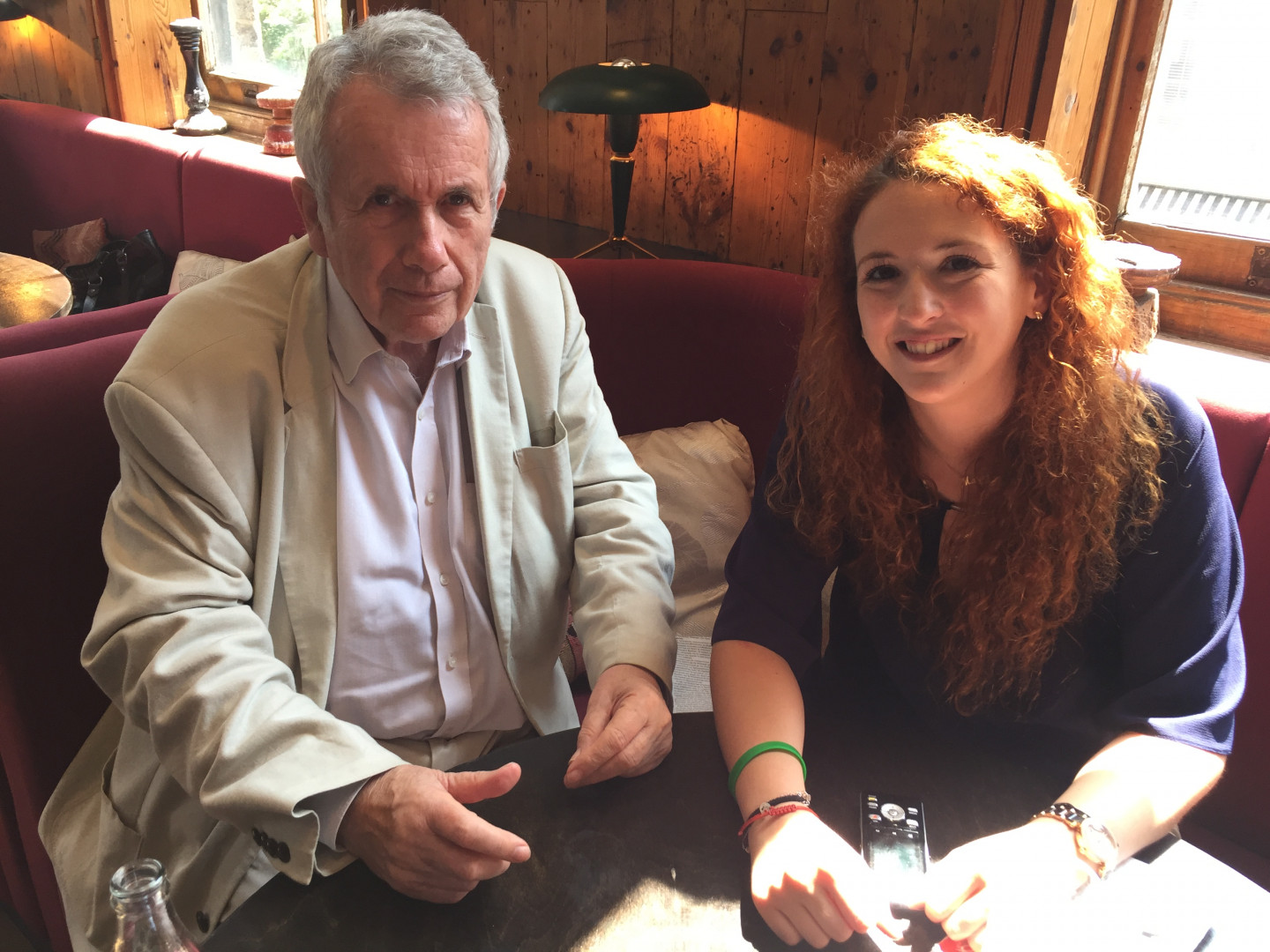

The man in the white suit talks to Parikiaki about his latest book “War and the Death of News”
By Mary Afxentiou
Former BBC war correspondent Martin Bell spent 34 years reporting from the world’s toughest warzones; from Vietnam to Iraq and Bosnia, he is in a position to offer a firsthand account of how news reporting has changed to meet the demands of a new era.
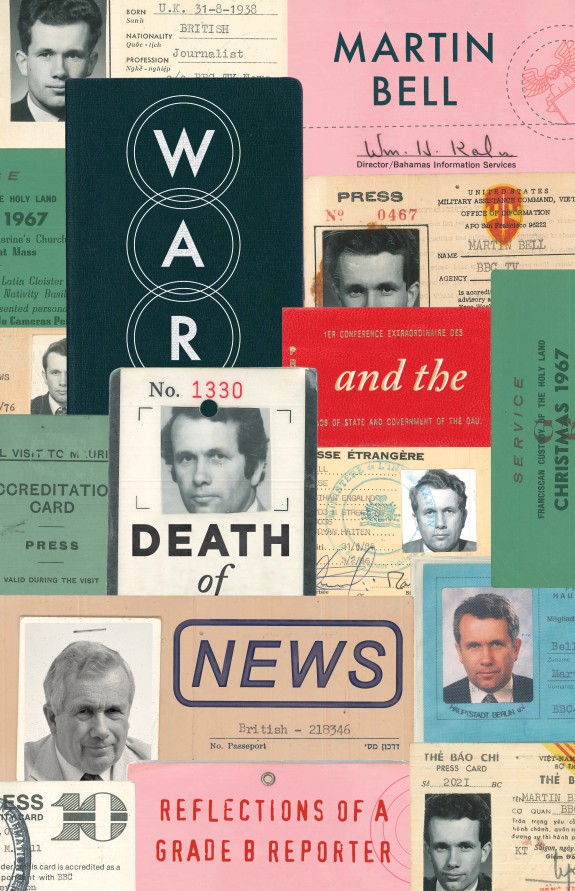
“Journalism as we have known it in the past has died”, he told Parikiaki’s Mary Afxentiou and George Charalambous as they caught up with him at the Frontline Club. This is the “gloomy” conclusion of his latest book “War and the Death of News”, which he underpinned after finding an old box full of papers in his attic last year.
The man in the white suit though, has not only been on warzones as a reporter. Between 1957 and 1959, he served as a soldier of the Suffolk Regiment in Cyprus, a period which he also examines in the book.
The “Death of News”… How did you reach that conclusion?
At the beginning of last year I found in my attic a box full of papers. I didn’t know that I had it but I kept it through all of these years. These were scripts, reports, press cards, propaganda leaflets, transcripts and evidence in the world crimes tribunal. I put them together and started writing about them. I realised that they led to a particular direction to the present age of fake news and alternative facts and to the terrifying situation in which we find ourselves.
I give some examples in the book about fake news in the past; journalists who made stories up just because they were against tough deadlines. What we have now, though, are websites that make money by promoting false news. This is very serious. The sort of reporting I did for 34 years was mostly war; it started in Vietnam and ended in Bosnia. You can’t do any of it now; it’s too dangerous. So the reporters go away, they tear across borders with the help of unverified videos, they find themselves on hotel rooftops and distant safe places and we don’t know really what is going on in Raqqa for instance; there is no authentic reporting coming out of Syria at all. And the gloomy conclusion of the book is that journalism as we have known it in the past has died.
Why are you so against the 24-hour news shows?
I actually hate it. The basic problem with the 24-hour news is that it shows more than it knows. It’s full of speculation and reports that later have to be corrected. I like slow news, where people go and find things out rather than just being in the newsroom.
If you were to start your career now, would you have chosen war reporting?
I think I would be a sports writer. Some of the best writing in the British papers is actually done by the football writers. They are charismatic; they run up against the tightest of deadlines.
Some of the big European matches end at around 9pm and they have to write the report backwards. The last thing they write is the opening paragraph. I think that I would be safer doing that.
You were in Cyprus during the Geunyeli massacre of 1958. What exactly happened on that day?
I was halfway through my 20 months in Cyprus that time. I was a very humble soldier; I was not an officer. I used to do roadblocks, while the Royal Horse Guards where in their fancy offices, not wanting to get dust on their shoes. In this particular time, in June 1958, we were dealing with some ferocious demonstrations by the Turks in the Turkish quarter of Nicosia. The Royal Horse Guards rounded up some Greeks who were hiding in a ditch. Because of the demonstrations in Nicosia, the Royal Horse Guards were not allowed to take them to the central police station.
They were instead taken to an area called Geunyeli and they were let go. This was a stupid thing to do just outside a large Turkish village.
In the book, you describe the “appalling cover-up” of what happened back then…
Two years ago I went through the archives and I found all the exchanges between the Governor and the Colonial Secretary and the appalling cover-up of what happened. The idea was that the report of the Chief Justice would be published in full, but it was put under such pressure that there were two reports; one was the full report and one was the report as it was censored with the criticism of the army taken out.
I think that the role the Governor played, though, was quite honourable. He was on the side of the Chief Justice, but the Colonial Secretary, Lennox-Boyd, who was a very right-wing character and belonged to the colonialist wing, overruled it. At the time the leading Greek Cypriots said ‘whitewash,’ ‘cover-up’ but they didn’t know the nature and the extent of it.
Having lived through that time I thought ‘how extraordinary, this is worth a chapter on its own.’
In “War and the Death of News” you mention that the murders marked the end of a dream of a free and united Cyprus. Do you think that if the British forces acted differently between 1955-59 division could have been avoided?
I think if we had adopted a softer, gentler policy, if our intelligence had been better, if the Army High Command had dealt more severely with incidents of indiscipline and if we had spent more time policing the flash points between the two communities and less time chasing shadows in the mountains, the outcome would have been different. This is why I believe that 1958 was the pivotal year; we should have prevented Geunyeli, which, I think, had a huge impact on the future of Cyprus.
Also, in 1974 we did not honour our guarantees at all. We had a role to play and we didn’t do it. But that is a different scandal. And we are here, for decades on with the Cyprus problem being one of the greatest tragedies in Europe and the second most unsolvable in the Middle East.
You previously mentioned that “lack of intelligence” was one of the main reasons of failure. Why was that?
Geunyeli was a Turkish village but the Royal Horse Guards did not know it. They didn’t know which areas were Greek and which Turkish. This is why I believe that lack of intelligence behind the military sense is the reason we failed on the island. If we had a cleverer policy, both militarily and diplomatically, we wouldn’t have failed. But instead, we focused on armed repression, which was an unworkable policy. You can’t hold a whole island by force.
It wasn’t helped, also, and I can see this now, by the misconduct of some British soldiers. For example the British army put the county regiments in Nicosia because we were better behaved and polite. They put the Scottish and Irish at the parachute regiment and the marines in the mountains, as they felt we were better dealing with riots.
There was an occasion when one of our rifle companies searched Kykko Monastery. A call came through the Battalion headquarters that night, complaining that the Archbishop’s grandfather
clock was missing. The commanding officers sent a lieutenant to where the soldiers lived and they found them putting the clock back together. They had stolen it. And rather than admitting they stole it, it was then disposed of in the latrines. And imagine, they were one of the better-behaved lot!
What was the perception of the Turkish and Greek Cypriots towards you as a soldier?
I found, given the considerable amount of grief that they were given, that the Greek Cypriots, and especially the young men of military fighting age, were amazingly civil. We would round them up in roadblocks and keep them in barbed wire pens. I felt really sorry for them because a lot of young men of military age were my age. These, along with the internment in Operation Match Box, which followed in July 1958, the curfews and the cordons, alienated your grandparents and parents and drove them to support EOKA even more. It took me a lot time to get there, but I can only describe it as armed repression; that’s what it was.
Have you witnessed any acts of torture yourself?
This would have been done by Military Intelligence and I think there was a court-martial of some Military Intelligence officers for the mistreatment of prisoners. The Government was fully aware that this was going on. I was just there sticking pins on maps and putting up posters. I did hear things though. On one occasion, one of the officers told me that there were roadblocks and when a bus came up an officer pulled out his gun and fired over the heads of these people to intimidate them. When the other officers heard about him, they beat him up. You do not shoot people like that; you should take things up the chain of command.
But I don’t want you to get the impression from my book that we were all thugs. We were innocent young men serving our Queen and country and ordered to put down a rebellion. There were 35000 of us and 200 of them. Likely armed, mostly hiding in caves and we still didn’t manage to put down the rebellion. I think EOKA was actually stronger in 1959 than in 1955.
Do you think if there was no EOKA, Cyprus would have still gained its independence?
I think eventually. Because we had only eight colonies left. There was an overcomplicated fact; we had a conservative right-wing government and the rebellion coincided with the debacle of the Suez Operation. That was hugely important, as it was a national humiliation to the British. Under a right-wing Tory government the theory was that after one humiliation we were not going to get beaten by 200 raggedy EOKA rabbits. But once more, we failed in intelligence.
You went back to Cyprus 10 years later. How was the situation at that time?
I went back to Cyprus in 1968 to interview President Makarios. When I visited Makarios at the Presidential Palace, he assured me that partition was not an option because the Turks lived all over the island. I doubted it; there was already a crackdown on the Turkish community. I went to see my two Turkish interpreters in the Turkish quarter and their cars were on wooden blocks, there was no petrol. I saw the poverty of Cyprus after the colonial part parted on both sides. I love your island; I just hoped that among the younger generation there is a will to get together. But the demographics have changed, Turks are coming from the mainland and this is another problem.
Many say that if British were there as a capacity in 1974, the invasion wouldn’t have taken place. What is your opinion on that?
I agree. If the British were there in full capacity the invasion would have not gone ahead. But this was an independent Cyprus; you really can’t have foreign police in the streets.
Do you think that other external forces played a major part?
Politics being played was a big part. Greece and Turkey were members of NATO and they were being led on. But looking back now I think there was a flawed structure of an agreement. The British got out as quickly as we could. We had a role to play that we didn’t play very well.
How would you describe the relationship between Cyprus and Britain today?
I think the post of the British High Commissioner in Cyprus is one of the most sensitive and important ones. They also have to deal with all these legacy issues like former detainees. I think there is a certain deep affection in spite of everything we did.