

Despite the low number of refugees arriving in Cyprus in the past year, it is believed that the flow as well as the number of people reaching Cyprus by sea will increase, the NGO Future Worlds Centre warned on Monday.
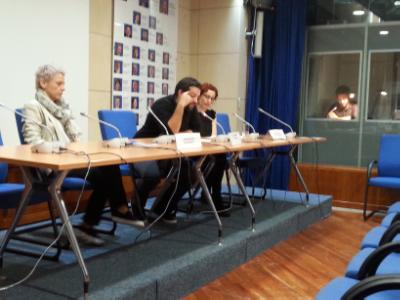
The position was outlined during a conference on the refugee crisis and recent developments and the situation in Cyprus. The conference was under the auspices of the Embassy of the Federal Republic of Germany.
Corina Drousiotou, in charge of the Humanitarian Affairs department of the FWC, said that they
have been very active in the area of asylum, offering assistance, both legal and social, to asylum seekers and persons under international protection and trying to promote and implement legislation, policies and practices.
“In spite of Cyprus` position being close to Syria, we still receive a very small number of refugees per year. Cyprus has not had the experiences of Greece, Italy or other countries of Central Europe. However, in the past 12 months, we had the first emergency boat rescues which were successful without victims and for this the FWC congratulated the authorities that handled them,” she said.
She said that in the past year there have been very positive developments with the percentage of recognition. Whereas in 2013-2014 the percentage of recognition was 4%, in the first six months of 2015, this went up to 73.12% by the asylum service and 53% by the refugee reviewing authority.
Drousiotou also said that the number of refugees receiving the convention status, recognised refugee instead of subsidiary protection and the number went up from 4% to approximately 11%.
Regarding asylum procedures, she praised the establishment of the administrative court for asylum procedures that will examine facts instead of merely law.
As far as the reception conditions are concerned, Drousiotou said that in the recent year the Reception Centre at Kofinou has reached its capacity for the first time since it was expanded and that it has a number of problems since it runs on skeleton staff and has practical problems.
A number of asylum seekers remain outside the centre, she said, in difficult conditions and the organisation has never received information from the authorities as to why such a small number are actually on social support scheme, adding that this is inadequate and is not able to cover their basic needs especially those with families and children.
Drousiotou also said that Cyprus has fallen behind in transposing the European Directives, specifically, the Asylum Procedures Directive as well as the reception conditions. The deadline was for July and it is still not clear when the transposition will take place.
She said that Cyprus will receive 72 million euro from the European Commission to support and manage asylum issues. However, all NGOs asked to be part in the designing of these schemes and we feel that we who have the knowledge are often excluded from this.
Future Worlds Centre advisor, Manos Mathioudakis, said that despite the low numbers, it is estimated that refugee flows to the island will increase, noting that “from September 2014 we see that they can include simultaneous and unexpected arrival by sea of dozens of people.”
Moreover, he said, because this is a clear refugee crisis, a significant number of applicants are expected to receive a positive response to their request for international protection which is long term situation.
Mathioudakis said that this is what the Republic of Cyprus is called to handle, relying on a system for receiving refugees and integrating them into society that has serious flows and weaknesses. He warned that if these problems are not dealt with, it will be impossible to ensure a decent living on the basis of assessment of personal needs of an individual and providing meaningful integration opportunities with the aim of social cohesion.
He also said that asylum seekers are not included in public aid programmes following an amendment to the legislation and receive nearly 50% less in aid which is not enough to cover their basic needs.
Asylum Service officer Lora Iacovides said that Navkratis programme (which refers to the mass arrival of persons in Cyprus seeking protection) has been involved in four rescue operations, the first on September 5, 2014 in Limassol with 345 people, the second in Larnaca on September 6, 2014 with 115 persons, the third on October 10, 2015 in Paralimni with 13 individuals and November 3 in Famagusta 26 persons. She also referred to the case of 114 refugees who arrived at the British Bases on October 21.
According to the programe, once refugees arrive, first they are registered and then housed temporary at Kokkinotrimithia. Then they transferred to the Asylum Seekers Accommodation Centre in Kofinou while unaccompanied minors are taken to Children`s Shelters. In the first rescue case, she said, only 107 people applied for asylum, in the second 105, the third 12
persons while the fourth is still an ongoing process.
Head of the European Commission representation in Cyprus, Giorgos Markopouliotis, said that the European Commission has increased the funds for the refugee crisis by 1.7 bn. euros. He added that in total, the Commission will allocate 9.2 billions for 2015 and 2016.
In his address, Counselor at the German Embassy Peter Neven said that this year Germany expects to receive up to one million refugees which is 40% of the number of refugees to come to the EU. He also said that this flow is expected to continue for some years noting that the answer is more and not less Europe.
Head of the European Parliament Office in Cyprus, Andreas Kettis, said that the right to asylum is at the heart of the European culture and civilization, adding that after the terrorist attacks in Paris this right has to be strengthened and the EU has to rise to the challenge.