

Five to six major Russian Investment Firms operating in Cyprus would be placed at risk because of the restrictive measures imposed by the EU to their parent companies in Russia, Demetra Kalogerou, Chairwoman of the Cyprus Securities and Exchange Commission (CySEC) has said. However, she noted that at present, these Russian subsidiary companies have capital adequacy.
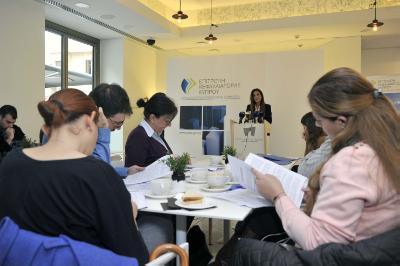
Speaking at a meeting with media representatives, during which she presented the past year`s most important developments in the sector supervised by CySEC as well as Commission`s priorities for 2015, Kalogerou also referred to the issue of Capital Securities holders, noting that the CySEC has proposed the involvement of the Financial Ombudsman on examining cases of investors of up to 175 thousand Euro.
Asked about the problems faced by Russian Investment Firms in Cyprus, Kalogerou said the problems concern the imposition of sanctions by the EU to their Russian parent companies. Due to those sanctions, the parent companies are not in a position to provide capitals to the subsidiary companies in Cyprus and in case those companies will be in a need of capital, they should be able to find those money from sources other than their parent companies.
Until now, she said, the Russian firms in Cyprus do not need money as their capital adequacy is not just 9% as it is the case with the Banks, but it reaches 16-20%. So, in case of some kind of stress test, such as the crisis with the Swiss franc, those companies can anticipate without affecting their capitals.
Presenting CySEC`s most important developments Kalogerou pointed out that Cyprus continues to offer significant advantages and constitutes an attractive jurisdiction for investments. “However, many challenges remain and hard work and collective effort is needed by all the players, not just to fully restore confidence in Cyprus,” she added, “but also to demonstrate that Cyprus remains a prestigious regional business centre,”.
Kalogerou said that the CySEC had continued in 2014 to contribute to the common effort for Cyprus to exit the financial crisis and return to growth. “The exercise of effective supervision is considered of paramount importance because it ensures not only the protection of investors but also the healthy development of the securities market, which constitutes a significant pillar of growth for modern economies,” she noted.
As regards the investigation of cases, the CySEC chairwoman said that inquiries completed in 2014 had shown violations of the law leading to administrative fines of €8.2 million. She added that in cases where possible criminal offences were exposed, the CySEC had forwarded the relevant data to the Attorney General of the Republic to decide whether the parties involved should be criminally prosecuted.
As for 2015, she said that the probe into pending cases would continue. “These cases concern possible misleading statements, evaluation of the data included in the financial statements of previous years as well as practices which could constitute market manipulation,” she explained.
Kalogerou said that in 2015 “we aim to strengthen the Supervision Department with human resources so as to further boost the supervision of the market through more checks, the full implementation of the supervisory framework which will be based on the risk management of supervised entities and through the provision of more guidance to those under supervision so that they can enhance their compliance further, in line also with the weaknesses identified by CySEC checks”.
In terms of informing and educating investors, Kalogerou said the CySEC had issued various informative articles and warning announcements, organised a seminar for financial journalists and produced short informative videos that will soon be uploaded to the CySEC’s upgraded website (www.cysec.gov.cy).