
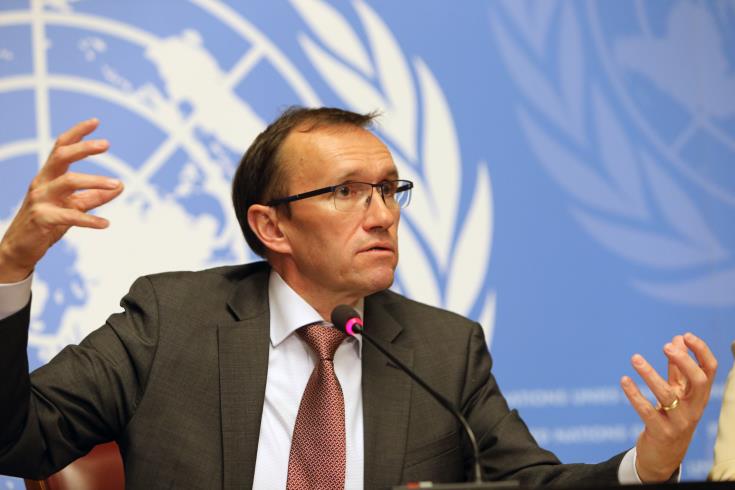

There are difficult issues to overcome on the security and guarantees chapter but there is will to overcome them, UNSG`s Special Adviser on Cyprus Espen Barth Eide said on Friday in Geneva during a presser, after the Conference on Cyprus which took place here on January 12.
Eide said that the opening statements made at the Conference “conveyed a strong message of hope that this long-standing dispute can now finally be laid to rest and a united federal Cyprus can emerge and be embraced in a security arrangement that is mutually acceptable for all sides.”
Invited to comment on statements by Turkish President Recep Tayyip Erdogan that Turkey will be in Cyprus for ever, Eide said that there were some exchanges on Thursday which were not on substance that might have inspired a reaction, adding that he has no sign that the process is in any kind of trouble. “But we take note of this,” he added. Asked if this issue concerns an exchange between the Turkish Foreign Minister and the President of the European Commission, Eide said that it was not that.
The UN diplomat noted that the last days have been quite a watershed moment for the Cyprus negotiations, while referring to the Conference of Cyprus that took place in Geneva on January 12 he said that “we had a very good series of opening statements that I listened to very carefully to. They all conveyed a strong message of hope that this long-standing dispute can now finally be laid to rest and a united federal Cyprus can emerge and be embraced in a security arrangement that is mutually acceptable for all sides,” he added.
Referring to the working lunch that followed he said that they went more into the actual substance of the issues and it was an open and frank exchange that confirm to us all two things: “first that there are difficult issues to overcome and secondly that there is a will to overcome them from all the participants and all the people present in that lunch.”
As regards the decision taken by the Conference, Eide said that on January 18 “senior civil servants will come together from the same parties to start working on specific ideas, specific possible options, possible proposals, not to negotiate but to prepare the ground for a structured final discussion between the principles at the very high political level which will take place late.”
He said that they deliberately did not set out a date for the Conference at the political level but it is going to be soon, maybe even in the course of this month.
Eide noted that the Conference convened successfully and continues as is normal in these conferences. Responding to a question he said that they shared ideas and inputs, and views. “I would not refer to them as proposals, because for me a proposal is somewhat more structured and this is something that will come in the second phase, at the civil servant level,” he noted.
As he said “we have creative ideas, every single intervention, both in the morning opening session which was somewhat more formal, and in the more informal exchanges, were very interesting in a sense that people came with thoughts, they did not come to only read aloud from an old papers. But it is not yet a proposal and this is what this group is going to do.”
The UN diplomat said that the issues discussed between Cyprus President Nicos Anastasiades and Turkish Cypriot leader Mustafa Akinci were close to conclusion but they were not completed here because there are issues in the five chapters discussed by the leaders “that can only be finally closed when we know what is happening also on the sixth chapters which is securities and guarantees.”
He said that in parallel with the Conference on Cyprus the two sides will continue to close outstanding issues because of this interdependent nature of issues.
“So under the roof of the Conference of Cyprus we have both phenomena going on in parallel and that is the way it should be,” he added.
He noted that “we are happy with where we are now”, adding that the working group established has already had initial exchanges here because they where all in Geneva.
“What they are doing as they fly home is that they are now preparing themselves for what will happen starting Wednesday- the session of the Conference on Cyprus- try to be much more specific on the issues.”
He said that this is not easy, but the will is there, stressing that “we must not lose any time and I really hope that all interested parties know that they are reflecting and preparing themselves for the meetings that will start on Wednesday, use that time optimally.”
“ There are not many days and I think that there is a momentum now. Larger political developments remind us that it is probably, or quite surely, very important to use these days as effectively as we can and in as constructive spirit as possible,” he noted.
Replying to a question, Eide said that some delegations wanted to start the next session right now, but one one delegation asked for a few days to prepare. That is not particularly dramatic, we are starting on Wednesday, in four or five days from now, and it is a continuous process. The conference is open, it is just that it happens in sessions and with the ambition to be close within a reasonably short time,” he noted.
Answering a question about the issue of guarantees, he said that “maybe what we know today can be substituted by something else. There is a will to look for this something else, but of course the only alternative is something that can be mutually agreed. The default option is that we remain where we are,” he added.
To a question about the EU role, Eide said that “they are not a participant in the conference, but they give advice and input to the conference adding that where the EU is relevant, they will convey expertise and support and input.”
Furthermore he said that the issue of rotating presidency was discussed in Geneva by the two leaders but there is not a conclusion on it.
On property, he recalled that there was a significant breakthrough more than a year ago, early in the talks, in finding the way to most adequately deal both with the rights of the dispossessed owners whose property rights will be fully respected, while also minimizing the hardship for current users.
“This framework is there for a long time, it is the final definitions that we have been struggling with, because, as I said, the devil is in the detail, and the small definition issues, for instance the nature of emotional link will have significant implications for who ends up on what side of the equation,”he added.
Asked what will happen with the maps that the two sides have submitted, the UN diplomat said that they will stay at the Palais des Nations until he decides otherwise. “That decision will be based on what the sides will want to do next on maps. So probably, at some point, when we re-open this issue to try to arrive at the final map, we will of course make reference to the proposals,” he added.
Replying to another question, Eide said that if there is full agreement on the five first chapters, it would make it easier to conclude the sixth chapter. “But it is unlikely to happen just that way,” he noted, adding that “not all security issues are in the chapter of security and guarantees, because security and guarantees principally relate to the treaties.”
Eide also noted that “people have to understand that in order to get something on one front, they need to give something on another front and that “ in order to negotiate successfully, you cannot try to win every battle.”
Responding to a question concerning the British Bases in Cyprus, Eide said that “the UK has previously promised that in the event of a reunification, some parts of the sovereign areas will be returned to Cyprus as some kind of reunification gift, and that promise has been reiterated lately, so this is still on the table.”
The Conference on Cyprus decided on Thursday to establish a working group at the level of deputies that will commence its work on 18 January with a view to identify specific questions and the instruments needed to address them.
According to the decision, the Conference will continue at political level immediately thereafter to review the outcome of the working group’s discussions, while in parallel, the negotiations on outstanding issues in the other chapters will continue between the two sides in Cyprus.
Cyprus has been divided since 1974, when Turkey invaded and occupied its northern third. Cyprus President Nicos Anastasiades and Turkish Cypriot leader Mustafa Akinci have been engaged in UN-led talks since May 2015 with a view to reunify the island under a federal roof.