
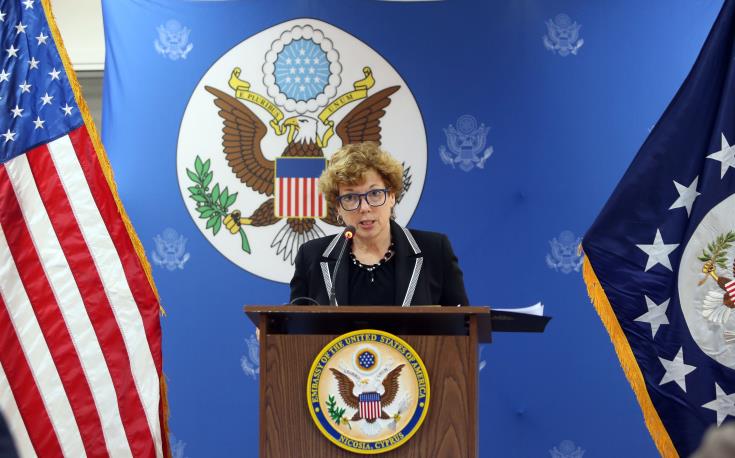

US Ambassador in Nicosia Kathleen Doherty has said that the US do not expect any problems from Turkey regarding vessels conducting surveys within Cyprus’ Exclusive Economic Zone (EEZ) on behalf of Exxon Mobil.
Doherty, who was replying to journalists’ questions during a press conference, clarified that Exxon Mobil’s activities “in the immediate few weeks right now is a survey vessel and we don’t expect any problems.”
She also pointed out that it often takes several years, maybe even decades, before all the conditions are right for revenue to begin flowing from energy resources and she stressed that the best way to work out how to share resources will be to have a Cyprus settlement.
In an introductory statement and referring to the hydrocarbons issue, Doherty said that “the United States has consistently reiterated its support for the Republic of Cyprus’ right to develop its resources in its EEZ.”
At the same time, she added, “we believe that the island’s gas and oil resources, like all its resources, should be equitably shared between both communities in the context of an overall settlement.”
It is clear, the US Ambassador stressed, “that a just and lasting settlement of the longstanding Cyprus problem would greatly facilitate the development of the resources and would ensure the benefit of all Cypriots.”
She explained that “exploratory activities do not necessarily mean there is a find and even if there is a deposit it may not be feasible to commercialise it and even if the oil and gas can be extracted, prices, including the cost of transporting the product may dictate waiting before entering the market.”
“It often takes several years, maybe even decades, before all the conditions are right for revenues to begin flowing,” she pointed out.
Political stability, the US Ambassador said, “economic growth and regional security all play large roles in the sequencing of events.”
“I don’t want to sound pessimistic, because I am not, but I do want to inject some realism and experience into the topic,” she continued.
According to the US official “the discoveries in the Eastern Mediterranean are important, they can interconnect and integrate the region, they can reduce dependence of individual countries on specific sources of energy and lead to increased economic and political cooperation.”
The resulting prosperity, she noted, “can strengthen democracies and bring much needed political and economic stability to the Eastern Mediterranean. It will also help diversify Europe’s energy supply and help meet the continent’s broader energy security needs.”
But, she pointed out, “it will take time for these benefits to accrue if the finds are there and the conditions are right.”
“I sincerely hope that both sides use that time to find a way to resume negotiations to reunify the island,” Doherty added.
“We believe that a great deal of progress was made by the leaders during the last round of negotiations and we continue to support Cypriot led efforts, facilitated by the United Nations,” she stressed.
Asked if she is optimistic that negotiations will resume, she said that she sincerely hopes so. “I have seen a lot of the progress that was made last time during the last round of negotiations and I think that that there is a very solid foundation from which to build upon,” she noted. The US Ambassador added that “I know that both leaders have expressed a desire to get back to the table and to start negotiations and I sincerely hope that starts soon.”
“There is no time frame to be finished but I do think that a lot of things are happening in the world and in the region and external factors that should encourage the two parties to get back to the table sooner than later,” she noted.
Replying to a question on whether the US government will support Exxon Mobil’s activities within Cyprus’ EEZ she specified that Exxon Mobil’s activities in the next few weeks are actually “a survey vessel which is very different than an exploratory rig.”
“I think there has been some misconception, these are actually two vessels to look at whether there are any archaeological finds in the sea and also to figure out where to drill,” she added.
“Exxon Mobil doesn`t actually intend to drill for several months, probably until the last quarter of this year and I think we have several months to focus on what really matters which is in my government’s opinion the settlement process,” she pointed out.
“I think there is a lot of time and that six months should be really taken advantage of, to make progress on the thing that really matters which is the settlement,” she added.
Replying to an additional question on the matter, Doherty reiterated that activities in the immediate few weeks, right now, “is a survey vessel and we don’t expect any problems.”
Obviously, she added, “in the next few months we have a very long and robust agenda with Turkey on many issues and we will continue to engage with Turkey on issues that affect the region.” This, she said, “is one of the topics among many and we will continue to have dialogue with Turkey.”
Replying to a question on whether Turkey’s involvement in Syria affects the Cyprus dispute too, she said that she does not want to comment specifically on Turkey as she is not the US Ambassador to Turkey.
“I do know that we have had very long discussions with Turkish officials recently and I don’t want to say that things have improved dramatically but they are improving,” she pointed out.
I think, she added, “that having a long conversation and a good relationship with Turkey and Greece and all the countries in the region will only have a positive impact on Cyprus and we are working on that.”
Asked about her opinion on the most logical sharing of energy resources is, she replied that she believes that “it really is for Cypriots to decide for themselves how to work out the mechanisms.”
She repeated however that “the revenue stream is at best many years away and so this intense focus on how to you share revenues – I hope there are revenues to be shared equitably, I hope that you find something significant on the island – but right now we are talking about a hypothetical, so I think that there is plenty of time and space to figure out the right mechanism by Cypriots, to figure out how to share their resources equitably.”
“We do think the best way to do it is to have an agreement, to have a settlement on the island, have reunification. It is the best way to figure out an equitable way to share resources,” she stressed.
She expressed the hope “for all Cypriots that there is a significant find but as I said at best it is five years away if not longer.”
So, Doherty added, “I think we need a lot of creativity a lot of thoughts on how to address the issue,” noting that “the priority for me should be the negotiations.”
Replying to a question about reserves discovered in block 12 of Cyprus’ EEZ, she explained that there is exploitation but there is also a revenue stream, that is a different thing, and that takes many years to develop. It is better to talk to the companies themselves who can tell you how they project. “It is my understanding that it doesn’t happen overnight,” she added.
Asked whether she thinks it is problematic for the US to support Cyprus’ right to develop its natural resources within its EEZ, she replied that “we do recognise the Republic of Cyprus and because of that we recognise the right of the Republic of Cyprus to develop its EEZ.”
“On issues where there is a dispute it terms of maritime boundaries, our global policy is not to take positions on who has right on the global maritime boundaries,” she added.
“We say that the parties should work it out themselves and not do anything that hinders or hampers a broader agreement on how to share or deal with resources. But we do not take sides on the particular issues of maritime boundaries,” she noted.
Assistant Secretary Mitchell in Cyprus on Friday
———
Ambassador Doherty also referred to a visit by US Assistant Secretary of State for European and Eurasian Affairs Wess Mitchell in Cyprus on Friday.
“He is actually responsible for our relations with 52 countries, Cyprus is one of them,” she said, adding that his trip is part of a broader visit to the region which includes Pristina, Skopje, Belgrade and Athens as well as Nicosia.
In Cyprus he will discuss regional security issues, management of Eastern Mediterranean energy resources, bilateral relations and the Cyprus problem, she added.
Asked whether there will be an initiative for the Cyprus problem by the US, she said “not at this moment.” She noted that this will be Assistant Secretary Mitchel’s first time in Cyprus and will be a chance for him to hear from all the actors in the island. It is really a chance for him to understand what all the dynamics are and then we will go on to discuss about what the possibilities might be, she said.
On a different note, the Ambassador talked about a visit later this week by the Chamber Choir from the Georgia Institute of Technology, who will hold two free public concerts in Nicosia on Thursday and Friday evening.