
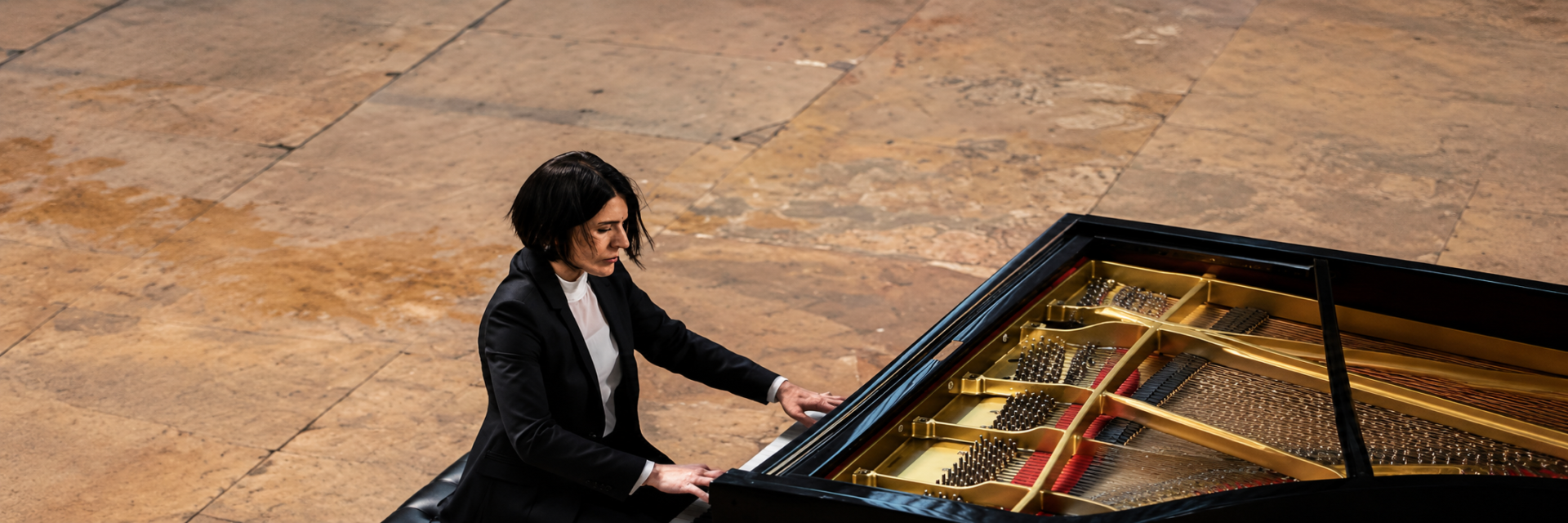

Mariam Batsashvili is a Georgian classical pianist. She started playing the piano at the tender age of 4 under Natalia Natsvlishvili. In 2014, she won the 10th Franz Liszt Piano Competition in Utrecht, after having already triumphed in the International Franz Liszt Competition for Young Pianists in Weimar in 2011. On Saturday evening she was in London, making her debut at The Queen Elizabeth Hall
There was something wonderfully refined about her playing: virtuosity certainly, and in abundance, but virtuosity placed entirely at the service of colour, character and expression. Her beautiful touch on the Yamaha concert grand was apparent throughout, capable of extraordinary delicacy without ever losing presence. The programme explored transcription and transformation, moving from Bach and Handel through Thalberg and Liszt to Busoni. Batsashvili seemed completely at home in this world. At times she appeared almost possessed by the Lisztian transcriptions, swept up in their theatricality and brilliance; at others she became soulfully absorbed, seeming to follow the dying sound with her eyes into the distance.
Liszt’s transcription of the Valse from Gounod’s Faust was thoroughly remarkable: sparkling, witty and vividly characterised, the music brought wonderfully to life rather than treated simply as a vehicle for pianistic display. After the interval came a personal favourite, Bach’s Chaconne in Busoni’s transcription. This was tremendously moving. The grandeur was there, but so too were tenderness, stillness and an extraordinary sense of the architecture unfolding naturally. I was reminded of Brahms’s famous response to the original Chaconne, describing how Bach creates “a whole world of the deepest thoughts and most powerful feelings.” Batsashvili somehow allowed us to hear both that inner world and Busoni’s monumental reimagining of it.
Liszt’s Après une lecture du Dante provided a suitably dramatic conclusion, encompassing demonic energy, sonority and moments of luminous reflection. But the most affecting moment came afterwards. As an encore Batsashvili played Chopin’s C-sharp minor Nocturne, dedicating it to her late teacher Natalia, whose birthday would have fallen that day. She spoke movingly of what her teacher had taught her about touch — about how truly to play piano and pianissimo.
What followed was exquisitely ethereal: intimate, suspended and intensely personal. After all the evening’s formidable virtuosity, it was perhaps this simplicity and refinement that remained most powerfully in the memory. There seemed scarcely a dry eye in the hall.
Iasonas Gallonbramma